
 by
by 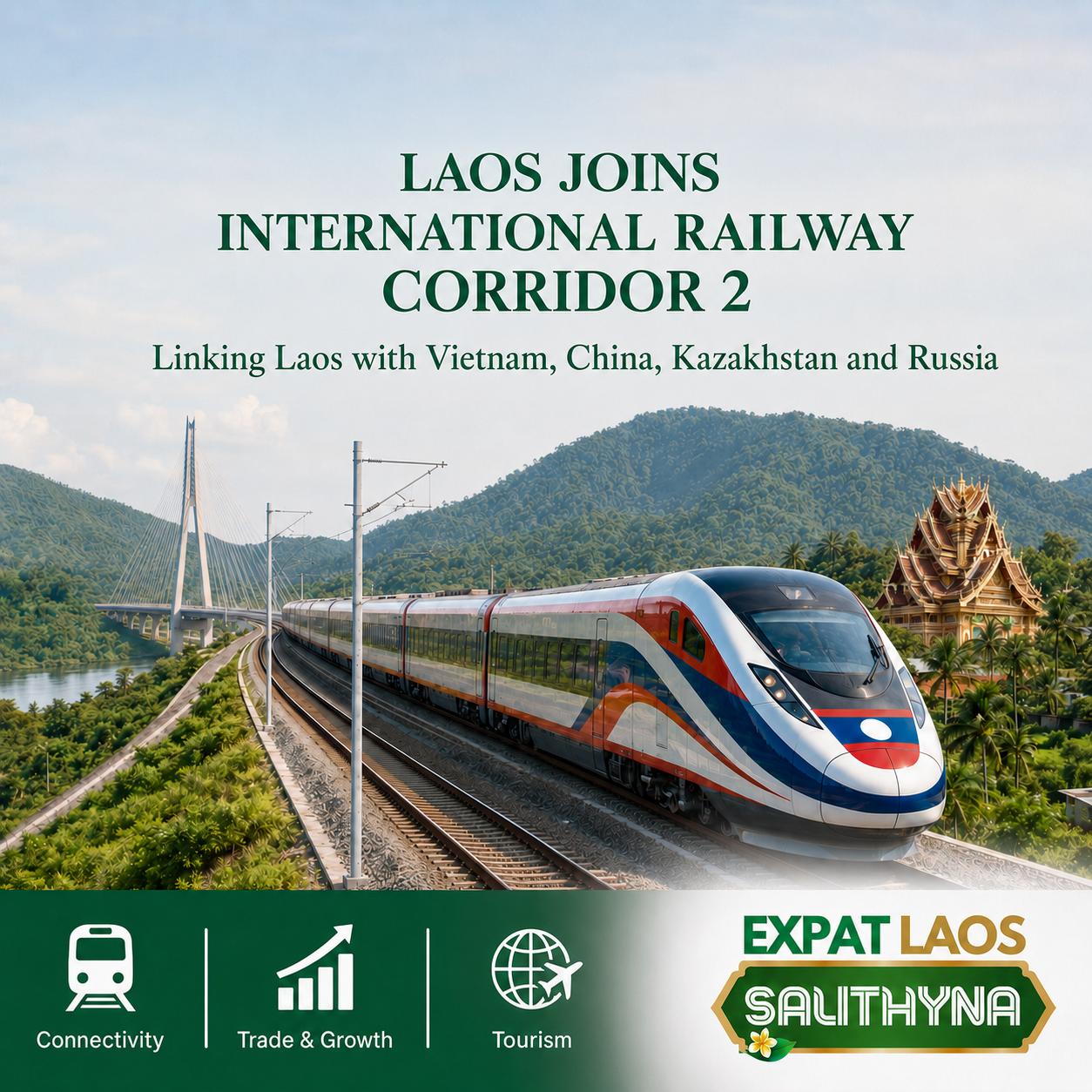
- Laos signed a Memorandum of Understanding (MoU) to join OSJD Corridor 2 during the 53rd Ministerial Conference, held in Dushanbe, Tajikistan, on June 11–12, 2026.
- The OSJD (Organisation for Cooperation between Railways) brings together 30 member countries across Asia and Europe and manages 13 international rail corridors.
- This accession links the Lao railway network to major transcontinental freight routes, strengthening the country’s position as a regional logistics hub.
- For businesses and expats in Laos, it signals new opportunities in import-export, logistics investment, and economic development.
A high-level delegation from the Ministry of Public Works and Transport represented the Lao People’s Democratic Republic at the 53rd OSJD Ministerial Conference. The Lao delegation was led by Deputy Minister of Public Works and Transport, Mr Ngampasong Muongmany. The conference discussed railway transport development and the integration of transport networks among member countries.
The main outcome was clear. According to the Ministry of Public Works and Transport, the signing of the Memorandum of Understanding on Laos’ participation in the Corridor 2 component was the key outcome of Laos’ attendance at the conference.
This signing comes at a notable moment for the organisation. The conference was held as the OSJD marks its 70th anniversary this year. For Laos, it represents the culmination of a process set in motion long ago, in parallel with the completion of the Laos-China railway line.
Many expats and entrepreneurs have never heard of this organisation — and that’s understandable: it operates behind the scenes of international freight. Yet its role is central.
The Organisation for Cooperation between Railways (OSJD) is an international organisation founded on 28 June 1956 in Sofia, Bulgaria. Its primary objective is to develop international rail traffic between Europe and Asia.
In practical terms, the OSJD sets the common rules that allow trains to move seamlessly from one country to another: technical standards, freight protocols, schedule coordination, and interoperability of locomotives and rail cars. This framework is what makes transcontinental corridors possible.
- 30 member countries across Asia and Europe (as of October 2025)
- 340,000 km of operational railway length across member countries
- 4 billion passengers transported per year on average
- 5.5 billion tons of freight carried per year on average
The OSJD system is built on a network of rail routes defined between Asia and Europe. Thirteen transport corridors operate within the OSJD system, geographically connecting almost all member countries from east to west and north to south. The foundations of these corridors were laid in 1996, based on the volumes of goods traded between the two continents.
By joining Corridor 2, Laos directly connects its national network to these major freight routes. For a country long described as landlocked, this is a structural shift: it is gradually becoming land-linked by rail to markets far beyond its immediate borders.
| Before | After Accession |
|---|---|
| Railway network mainly for domestic and bilateral use | Integration into a structured international rail system |
| Peripheral position in Asian logistics | Transit point within a Eurasian supply chain |
| Reliance on maritime routes through neighbouring ports | A rail alternative to distant markets |
This is where the topic becomes relevant for anyone who lives, works, or invests in Laos. Beyond the ceremony, it is the economic consequences that matter.
Better rail integration means less friction at borders, more predictable transit times, and potentially lower logistics costs. Businesses based in Laos can begin to consider freight routes to markets that were once hard to reach.
Developing a logistics hub generates economic activity: new jobs, new businesses, and rising demand for services and housing. For expat entrepreneurs, it’s a fast-moving environment worth following closely.
Laos’ accession to OSJD Corridor 2 is far more than a diplomatic formality. It marks a step in the country’s transformation — from a landlocked state into a connected link in the major Eurasian logistics chains. For economic players and expats already on the ground, it is a development to factor into any strategic thinking about the future of Laos.
- Connection: the Lao network is now tied into an international rail system spanning 30 countries.
- Opportunity: import-export, logistics investment, and new economic activity are the expected outcomes.
- Follow-up: complementary projects (the Laos-Vietnam line) will extend this momentum — a topic to watch.
At Salithyna, we closely follow the developments shaping the economic future of Laos. To support your relocation, your business, or your investment project in Laos, find our advice and services on our contact page. Our team helps with visas, housing, relocation, and everything that makes life in Laos easier.