 by
by 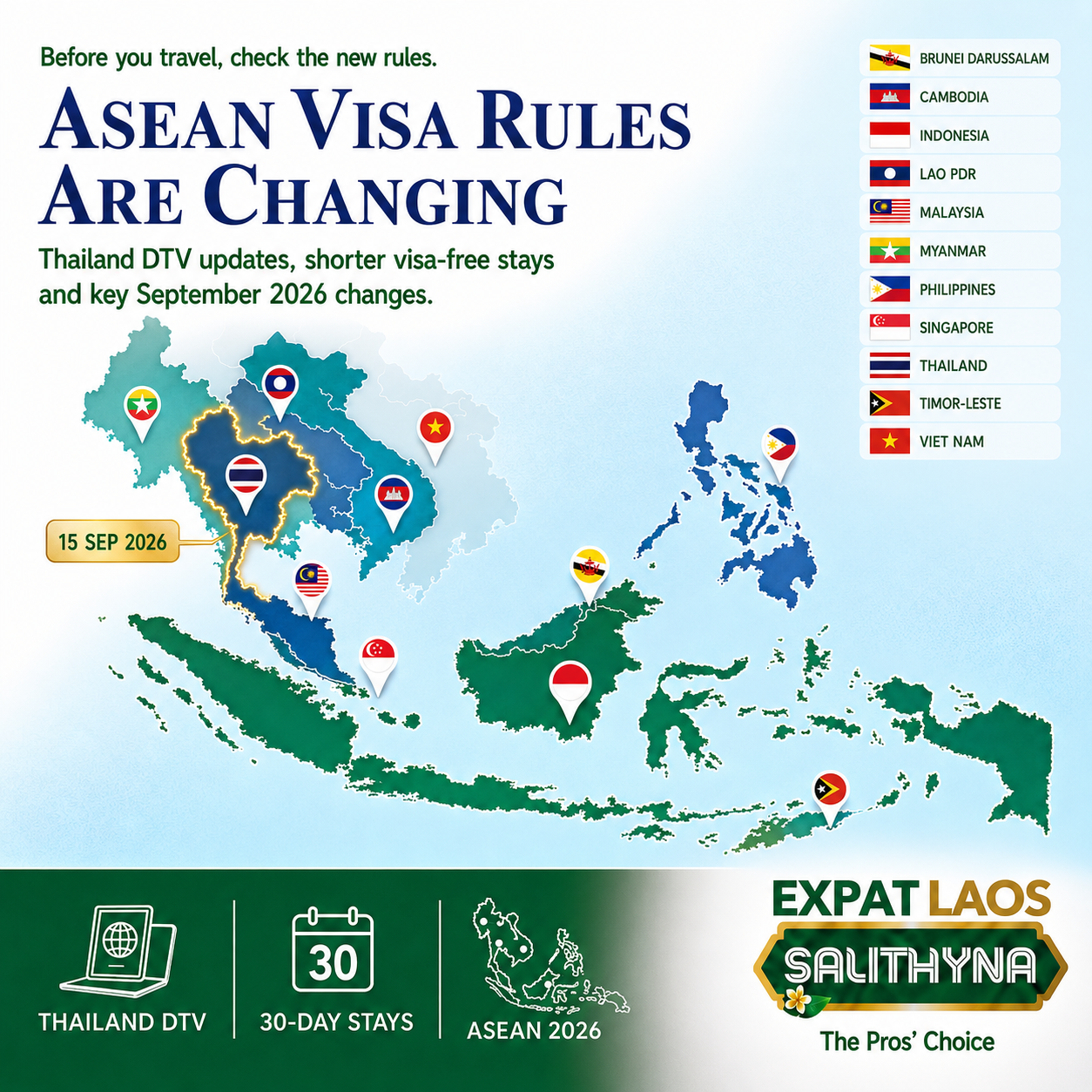
Visa rules across Southeast Asia are moving again — and the two changes that matter most to anyone living in Laos both come from Thailand.
ASEAN visa updates 2026 — September edition. Thailand tightened its Destination Thailand Visa documentation on 31 August 2026, and its 60-day visa-exemption stay ends on 15 September 2026. Malaysia has narrowed access to multiple-entry visas, Cambodia has expanded and redesigned its eVisa system, and other governments across the region sit at very different stages between proposal, announcement and implementation.
This briefing separates confirmed rules from measures that are still pending. It covers all 11 ASEAN member states, including Timor-Leste, which was admitted to ASEAN in October 2025. Every status below was checked against official government, embassy and immigration sources on 4 September 2026.
Official reference: ASEAN — Timor-Leste admitted into ASEAN
⚡ QUICK ANSWER
From 31 August 2026, a Thailand DTV application must be lodged in the country where you hold nationality or permanent residence, with a criminal-record clearance — which largely ends tourist-based DTV applications in Laos. From 15 September 2026, Thailand’s 60-day visa exemption is replaced by a 30-day exemption for 60 countries and territories. Everything else in the region is either a narrow technical change or still only a proposal.
📋 7 Key Takeaways
- Thailand DTV applications became more restrictive on 31 August 2026: applicants now need a clear nationality or permanent-residence connection to the country where they apply, plus a criminal-record certificate.
- Thailand’s 60-day visa-exemption stay ends on 15 September 2026. A 30-day exemption will apply to 60 nationalities, with shorter or different treatment for some passports.
- Land-border entries are the quiet trap. Visa-exempt travellers are generally limited to two land entries per calendar year, with a published exception for four ASEAN nationalities.
- Malaysia restricted multiple-entry visa availability from 1 September 2026 — which is not the same as cancelling visa-free entry for other nationalities.
- Cambodia expanded its eVisa categories and moved from a barcode to a QR-coded eVisa.
- Indonesia’s higher visa-on-arrival fee remains a proposal, and the Philippines’ Digital Nomad Visa still lacks a visible official application route.
- Timor-Leste and Vietnam have advanced an ordinary-passport waiver agreement, but no commencement date has been published.
⚡ KEY DISTINCTION
“Announced”, “approved”, “effective” and “available to apply for” are not interchangeable. This briefing labels each development according to the strongest status that could be verified on 4 September 2026.
1. What changed across ASEAN in September 2026?
🌏 The 11-country update tracker
| Country | Verified status | Recent development | What travellers should do |
|---|---|---|---|
| Brunei | No major new rule found | No material national visitor-visa change identified in the review window. | Check eligibility with Brunei MFA before booking. |
| Cambodia | Effective | eVisa categories A, B and C added from 1 August; QR format replaces the former barcode. | Use the official eVisa portal and complete Cambodia e-Arrival when required. |
| Indonesia | Proposed, not effective | Higher VOA / e-VOA fees have been proposed, but the official eVOA portal still shows IDR 500,000 for 30 days. | Pay only the amount displayed on the official portal at the transaction stage. |
| Laos | No major new rule found | No nationwide tourist-visa change identified between 1 August and 4 September 2026. | Use the official Lao eVisa portal and confirm the permitted entry point. |
| Malaysia | Effective | Multiple-entry visa availability restricted to 31 nationalities from 1 September; photo verification announced for relevant VDR / eVAL cases. | Do not assume an older MEV list is still valid; recheck the official portal. |
| Myanmar | No major new rule found | No material nationwide visitor eVisa change identified in the review window. | Check official eligibility and current travel advisories before travel. |
| Philippines | Framework announced; route not live | The Digital Nomad Visa has a policy framework, but no visible application route appears on current Bureau of Immigration or eVisa pages. | Do not pay an intermediary until an official application channel is published. |
| Singapore | Process update | The SG Arrival Card interface added language options and passport-scan autofill for eligible residents. | Submit the arrival declaration within the permitted three-day window; it is not a visa. |
| Thailand | Effective / imminent | DTV documentation tightened on 31 August; the 60-day exemption ends on 15 September and is replaced by shorter stays for covered passports. | Recalculate permitted stay and verify where you are eligible to apply for a DTV. |
| Timor-Leste | Agreement pending implementation | The government approved draft parliamentary resolutions for a Vietnam–Timor-Leste ordinary-passport waiver; no public start date identified. | Wait for an official commencement notice before relying on the waiver. |
| Vietnam | No broad new rule identified | The national eVisa remains available for stays of up to 90 days, single or multiple entry, subject to eligibility. | Use the official government eVisa domain and verify approved ports of entry. |
2. Thailand DTV: what are the stricter application rules from 31 August 2026?
Thailand’s Destination Thailand Visa remains a five-year multiple-entry visa. It can allow stays of up to 180 days per entry for eligible applicants such as remote workers and digital nomads, participants in approved “soft power” activities, certain medical or event visitors, and eligible dependants. The core financial threshold remains evidence equivalent to at least THB 500,000, subject to the relevant embassy’s documentary requirements.
The important change is where and how a person may apply. From 31 August 2026, applicants must show that they are a national or permanent resident of the country where the application is lodged. A criminal-record clearance is also required, and missions may impose their own rules on validity, translation, legalisation and certification.
📄 DTV essentials after 31 August 2026
| Item | Verified position on 4 September 2026 |
|---|---|
| Visa type | Five-year multiple-entry visa |
| Stay per entry | Up to 180 days for eligible applicants |
| Eligible profiles | Remote workers and digital nomads, approved “soft power” activities, certain medical or event visitors, eligible dependants |
| Financial evidence | Equivalent of at least THB 500,000, subject to each mission’s documentary rules |
| New from 31 August 2026 | Nationality or permanent residence in the country of application, plus a criminal-record clearance |
| Applications filed and paid before 31 August | Described as unaffected by the new filing-location requirement |
| DTVs already validly issued | Not automatically cancelled by the new documentation rules |
🇱🇦 Can a tourist apply for the Thailand DTV in Laos?
In practical terms, generally no. Thailand’s official pages for Vientiane and Savannakhet state that applicants must be Lao nationals or permanent residents of Laos. They also explain which criminal-record certificate is expected. Someone visiting Laos as a tourist should not plan a DTV application there unless the mission confirms eligibility in writing.
If your plan was to base yourself in Laos and work remotely for clients abroad, it is worth separating two questions that are often merged: which visa lets you stay, and which status lets you invoice. Our guide to starting a business in Laos as a foreigner in 2026 covers the second one.
Official references: Thai e-Visa — Destination Thailand Visa • Thai MFA announcement • Royal Thai Embassy Vientiane • Royal Thai Consulate-General Savannakhet
3. Why does Thailand’s 60-day visa exemption end on 15 September 2026?
Thailand has announced a new visa-exemption structure effective 15 September 2026. The broad 60-day exemption introduced earlier will end. Under the new arrangement, nationals of 60 countries and territories will receive a 30-day visa exemption, while a small number of passports move to shorter stays or to visa on arrival.
The 30-day list includes many of the passports most commonly carried by Expat Laos readers, including France, the United Kingdom, the United States, Canada, Australia, most European Union states, India, Indonesia, Malaysia, the Philippines and Singapore. Lao ordinary-passport holders continue to rely on the bilateral 30-day arrangement rather than the general exemption list.
📊 Thailand’s visa exemption from 15 September 2026
| Traveller category | Treatment under the published change |
|---|---|
| Nationals of 60 countries and territories | 30-day visa exemption |
| Mauritius and Seychelles | 15 days |
| Azerbaijan, Belarus and Serbia | Move to visa on arrival |
| Lao ordinary passports | Bilateral 30-day arrangement, not the general exemption list |
| Visa-exempt land-border entries | Generally limited to two per calendar year |
| Land-border exception | Nationals of Brunei, Indonesia, Malaysia and Singapore |
Border officers still retain authority over admission, and a visa exemption is never a guarantee of entry.
⚡ FOR LAOS-BASED TRAVELLERS
A Thai entry made before 15 September and one made on or after 15 September may produce different permitted-stay dates. Check the admission stamp before leaving the checkpoint, and keep a record of your land-border entries during the calendar year. If you are weighing a flight against a bus to the bridge, our 2026 guide to airports in Laos sets out the realistic options.
Official references: Tourism Authority of Thailand announcement • Thai MFA — bilateral ordinary-passport agreements
4. What exactly did Malaysia restrict on 1 September 2026?
Malaysia’s Immigration Department announced that multiple-entry visas would no longer be available to all nationalities from 1 September 2026. The facility is now limited to 31 listed nationalities. This is a change to MEV access; it should not be misreported as a blanket cancellation of Malaysia’s visa-free arrangements.
Older agent pages and copied nationality lists may therefore be unreliable. Applicants should verify their passport on the official immigration or visa portal immediately before filing. Separately, Malaysia’s Expatriate Services Division announced photo-verification requirements for relevant Visa With Reference and eVAL processes from 21 August 2026.
Official references: Malaysia Immigration — MEV notice • Malaysia ESD — photo verification
5. What is new in Cambodia’s eVisa system?
Cambodia expanded its electronic visa system on 1 August 2026 to include Type A diplomatic, Type B official and Type C courtesy visas. The government also replaced the former eVisa barcode with a QR code. Travellers with an approved eVisa should carry the current confirmation format and continue to complete Cambodia’s separate e-Arrival process when required.
Cambodia also announced a temporary 14-day visa-free arrangement for Chinese tourists from 15 June to 15 October 2026, subject to the stated conditions and e-Arrival formalities. This is a time-limited measure and should not be projected beyond the published end date.
Official references: Cambodian mission — eVisa expansion • Cambodia eVisa news • Official Cambodia eVisa portal
6. Is Indonesia’s higher visa-on-arrival fee already in force?
No. Indonesian immigration officials have discussed increasing the electronic visa-on-arrival fee to IDR 750,000 and the counter-issued visa-on-arrival fee to IDR 1,000,000. However, no effective date was identified in the reviewed material. On 4 September 2026, the official eVOA portal continued to display IDR 500,000 for a 30-day visitor stay.
The practical rule is simple: treat the increase as a proposal until an official portal or regulation states a commencement date. Avoid paying unofficial websites that present the proposed amount as if it were already mandatory.
Official references: Official Indonesia eVOA information • Industry report on the proposed fee increase (non-governmental source)
7. Can you apply for the Philippines Digital Nomad Visa yet?
The Philippines created a Digital Nomad Visa policy framework in April 2025. Yet, as of the verification date for this article, the Bureau of Immigration visa pages and the official eVisa portal did not show a clear live Digital Nomad Visa application route.
Prospective applicants should therefore describe the programme as announced, not fully operational. Do not pay an agent merely on the promise of early access. Wait for an official checklist, fee, filing channel and implementation notice from the Philippine authorities.
Official references: Philippines Bureau of Immigration — visas • Official Philippines eVisa portal
8. Where do Vietnam and Timor-Leste stand on their visa waiver?
On 2 September 2026, Timor-Leste’s Council of Ministers approved draft parliamentary resolutions linked to an ordinary-passport visa-waiver agreement with Vietnam. The agreement had been signed on 9 June and covers tourism and transit in the government’s description. No public start date was identified in the announcement reviewed for this article.
Until both governments confirm commencement and the permitted duration, travellers should continue to follow the existing rules. Vietnam’s official eVisa remains available for eligible travellers for stays of up to 90 days, with single- or multiple-entry options.
Official references: Government of Timor-Leste — Council of Ministers, 2 September 2026 • Official Vietnam eVisa portal
9. What changed with Singapore’s SG Arrival Card?
Singapore updated the SG Arrival Card experience in late August 2026 with additional language options and passport-scan autofill for eligible residents. The SG Arrival Card is an arrival declaration — not a visa, and not permission to work. Travellers should submit it only through the official Immigration & Checkpoints Authority channel within the permitted three-day period before arrival, including the day of arrival.
Official references: Singapore ICA — entering Singapore • Law-firm summary of the process update (non-governmental source)
10. Did anything change for Brunei, Laos and Myanmar?
No material nationwide visitor-visa change was identified for Brunei, Laos or Myanmar in the review window from 1 August to 4 September 2026. That does not mean every operational detail is static: eligible nationalities, entry points, documentary requirements and processing conditions can change without becoming a major policy headline.
For Laos in particular, eVisa holders should continue to verify which ports of entry accept the electronic approval — a point we detail in our complete guide to the Laos short-stay tourist visa. Travellers to Myanmar should also review current security and travel-advisory information in addition to visa eligibility.
Official references: Brunei MFA visa information • Official Laos eVisa • Official Myanmar eVisa
11. What do these changes mean if you live in Laos?
📋 Five practical consequences
- Do not plan a Thailand DTV run from Laos unless you can prove Lao nationality or permanent residence and satisfy the criminal-record requirement.
- Recalculate Thailand travel after 15 September 2026. A 30-day permission may replace the 60-day stay you expected.
- Track your Thai land-border entries. Visa-exempt travellers are generally limited to two land entries per calendar year.
- Do not confuse an arrival card with a visa. Singapore’s SG Arrival Card and Cambodia’s e-Arrival are declarations, not substitutes for visa eligibility.
- At payment stage, verify the government domain, the official fee and the precise product name. A proposed fee or an announced programme may not yet be operational.
✅ Final pre-travel checklist
- Confirm the rule for your exact passport, not simply your country of residence.
- Separate visa validity from permitted stay per entry.
- Check whether a change is proposed, announced, effective or actually open for applications.
- Use official government portals and recheck the displayed fee before payment.
- Carry digital and printed copies of approvals, onward-travel evidence, accommodation details and insurance where relevant.
- Remember that visitor status or a digital-nomad visa does not automatically authorise work for local clients or a local employer.
⚡ EDITOR’S NOTE
Visa rules can change between booking and arrival, and border officers retain discretion. Confirm the current rule with the competent embassy, immigration authority or official portal immediately before travel.
🌿 Planning your move to Laos?
Expat Laos SALITHYNA supports expatriates, families and entrepreneurs in Vientiane with visas, relocation, housing and company setup — with the paperwork handled locally and explained in plain language. Discover our services. expatlaos-salithyna.com
WhatsApp: +856 20 57 935 574 — Email: contact@salithynagroup.com
❓ Frequently asked questions
What changed for the Thailand DTV in August 2026?
From 31 August 2026, applicants must demonstrate nationality or permanent residence in the country where they lodge the application and provide a criminal-record clearance, subject to mission-specific documentation rules.
Can a tourist apply for the Thailand DTV in Laos?
Generally no. The official Thai pages for Vientiane and Savannakhet limit applications to Lao nationals or permanent residents of Laos.
Is Thailand’s 30-day visa exemption already in force on 4 September 2026?
No. The announced effective date is 15 September 2026. Until then, the rule applicable on the actual arrival date must be checked.
Does Indonesia’s visa on arrival now cost IDR 1,000,000?
Not according to the official eVOA information reviewed on 4 September 2026. The higher figures remain proposed; the official online fee was still shown as IDR 500,000 for 30 days.
Can I apply for the Philippines Digital Nomad Visa now?
A policy framework exists, but no clear live application route was visible on the reviewed official immigration and eVisa pages. Wait for an official filing channel.
Is an arrival card the same as a visa?
No. An arrival declaration may be mandatory, but it does not replace a visa or a visa exemption, and it does not itself authorise employment.
Which ASEAN country has the most important immediate change for Laos-based travellers?
Thailand. The DTV filing restrictions affect applications made from Laos, and the shorter visa-exemption regime begins on 15 September 2026.
📚 Sources and fact-check references
- ASEAN — Timor-Leste admitted into ASEAN
- Thailand e-Visa — Destination Thailand Visa
- Thailand MFA — DTV documentation announcement
- Royal Thai Embassy Vientiane — visa applications
- Royal Thai Consulate-General Savannakhet — DTV
- Tourism Authority of Thailand — exemption rules from 15 September
- Thailand MFA — bilateral ordinary-passport agreements (PDF)
- Malaysia Immigration — MEV announcement
- Malaysia ESD — photo verification for VDR / eVAL
- Cambodian mission — expanded eVisa categories
- Cambodia eVisa — official news • Cambodia eVisa — official portal
- Indonesia — official eVOA information
- Philippines Bureau of Immigration — visas • Philippines — official eVisa portal
- Timor-Leste Government — Council of Ministers, 2 September 2026
- Vietnam — official eVisa portal
- Singapore ICA — entering Singapore
- Brunei MFA — visa information
- Laos — official eVisa portal • Myanmar — official eVisa portal
- Non-governmental sources used in support only: report on the proposed Indonesian VOA fee and summary of the SG Arrival Card update.
🔗 Continue exploring life and business in Laos
- Laos Visa 2025–2026: Complete Guide to the Short-Stay Tourist Visa — the evergreen companion to this update, with entry points, durations and the eVisa process in detail.
- How to Obtain a Lao Visa: A Step-by-Step Guide for Expats and Travelers — the practical walkthrough if you are applying for the first time or renewing from inside the country.
- Moving to Laos in 2026: The Complete Relocation Checklist — what to prepare before, during and after arrival once your visa question is settled.
- Starting a Business in Laos as a Foreigner in 2026: Visas, Company Setup, Tax and Market Realities — for remote workers who need a legal way to invoice rather than another tourist stamp.
- Cost of Living in Laos: A 2025 Guide for Expats — the budget context behind any decision to base yourself in Vientiane rather than Bangkok or Chiang Mai.
By Clem-Titsada, co-founder of Salithyna Group. Franco-Lao and based in Vientiane, she has been developing professional services adapted to international standards and to the realities of Laos since 2022.
This article is general information, not legal or immigration advice. Eligibility depends on nationality, residence status, travel history, supporting documents and the decision of the competent authority. Always verify the rule applicable on the date of application and the date of travel.