
 by
by 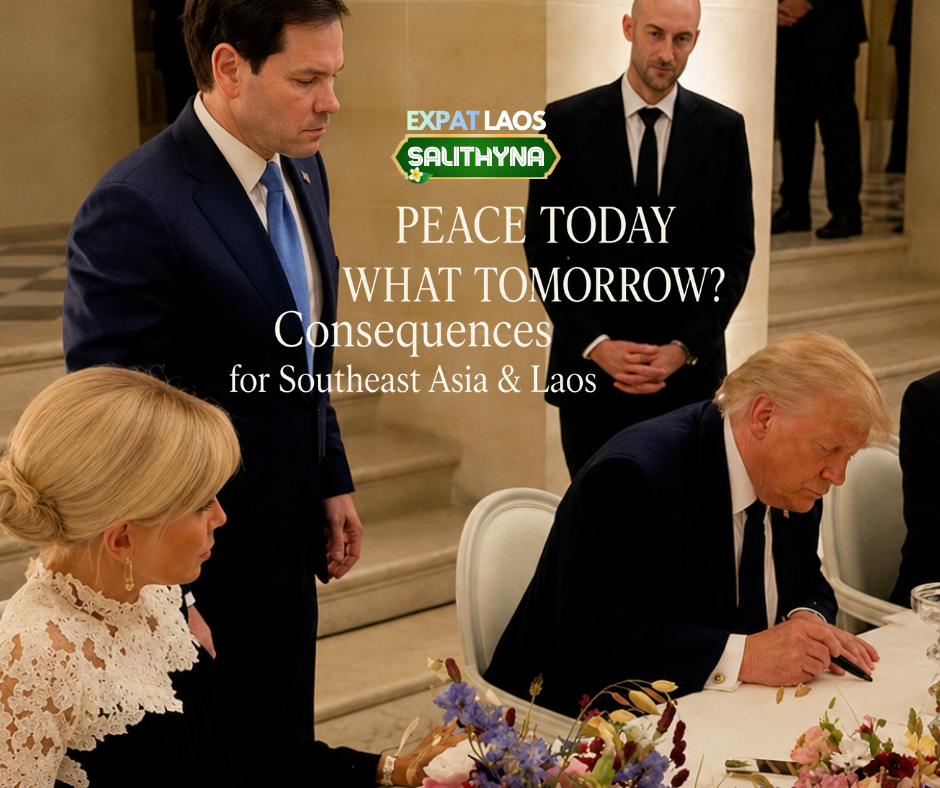
On February 28, 2026, US-Israeli airstrikes triggered a war against Iran. Tehran’s response was immediate and radical: the closure of the Strait of Hormuz — the 34-kilometre-wide maritime chokepoint through which, in normal times, 20% of the world’s oil supply, 30% of global urea production and significant volumes of LNG transit every day. Within weeks, the conflict had also engulfed Lebanon via Hezbollah.
The global economic fallout was swift. Maritime traffic through the Strait collapsed from 160 vessels per day in late February to just 11 per day on average in April. Brent crude soared past $126 per barrel, its highest level since 2022. Asia — which absorbs 75% of Gulf petroleum exports — was hit hardest of all.
A landlocked country heavily dependent on Thai imports, Laos bore the full brunt of the energy price spike. Fuel, transport costs, food prices, expat relocation services: virtually everything increased after March 2026. Expats in Vientiane — whether renting villas, managing property investments or running businesses — saw their cost of living rise noticeably within weeks of the conflict beginning.
Signed electronically on June 18, 2026 — Donald Trump from Versailles, Iranian President Massoud Pezeshkian from Tehran — the Memorandum of Understanding is a 14-point document published by Bloomberg and the New York Times. This is not yet the final agreement: it is a 60-day framework to reach one, ultimately ratified by a binding UN Security Council resolution.
| # | Commitment |
|---|---|
| 1 | Immediate and permanent ceasefire on all fronts — Iran, Lebanon |
| 2 | Lifting of the US blockade on Iranian ports (full completion within 30 days) |
| 3 | Reopening of the Strait of Hormuz to commercial vessels (toll-free for 60 days) |
| 4 | Demining of the Strait under IAEA / international supervision |
| 5 | Iran: formal commitment to never develop or produce nuclear weapons |
| 6 | Nuclear status quo maintained for the duration of the 60-day negotiation period |
| 7 | USA: immediate Treasury waivers for Iranian crude oil and petrochemical exports |
| 8 | USA: progressive release of Iran’s frozen assets held abroad |
| 9 | USA: facilitation of a $300 billion reconstruction and development fund for Iran |
| 10 | Withdrawal of US forces from Iran’s vicinity within 30 days of the final agreement |
| 11 | Full and permanent lifting of all US sanctions against Iran (final agreement) |
| 12 | Final agreement to be concluded within 60 days, binding UN Security Council resolution |
| 13 | Guarantees of Lebanon’s territorial sovereignty and integrity |
| 14 | Fate of Iran’s enriched uranium stockpiles defined in the final agreement (IAEA dilution) |
“This is not final. This is a memorandum of understanding. If I don’t like it, if they don’t behave, we’ll start dropping bombs on their heads again.”
The warning is explicit: the deal remains conditional on Iranian conduct throughout the 60-day negotiation period.
The protocol distinguishes three distinct phases. Here is what happens concretely at each stage — critical intelligence for expats in Southeast Asia, property investors in Laos, and anyone tracking regional markets.
- Cessation of military hostilities on all fronts, including Lebanon
- Immediate lifting of the US naval blockade on Iranian ports (30 days for full completion)
- US Treasury waivers: Iran resumes exports of crude oil, petrochemicals and LNG
- Strait of Hormuz reopens to commercial shipping (toll-free for 60 days)
- Demining operations begin under international supervision
- Oil prices drop: –5% on announcement day, Brent toward $83/barrel
- Nuclear file: dilution of enriched uranium stockpiles under IAEA supervision
- Progressive lifting of US sanctions against Iran
- Release of Iran’s frozen assets held abroad
- Negotiation of the $300 billion reconstruction fund framework
- Withdrawal of US forces from Iran’s proximity
- Continued normalisation of Hormuz shipping traffic
- Final agreement submitted to the UN Security Council (binding resolution)
- Full and permanent lifting of all US sanctions against Iran
- Complete normalisation of Strait of Hormuz traffic (with possible Iranian service fees)
- Brent crude expected to return to $60–70/barrel by end of 2026 (pre-war level)
Iranian Parliament Speaker Ghalibaf was unambiguous: “The Strait will not return to its pre-war situation. Iran has sovereign rights over Hormuz and will charge a fee for these services.” Analyst Philippe Chalmin confirms: “The Strait of Hormuz will never be totally as it was before.” For Asian importers — including ASEAN countries like Laos and Thailand — this means a structurally slightly higher long-term cost on hydrocarbons.
This deal fundamentally redraws the global geopolitical map. For expats, real estate investors in Asia and international relocation professionals, understanding these power shifts is essential to anticipating market movements ahead.
Washington achieves its core short-term objectives: Hormuz reopens, ceasefire holds, Iran commits to non-nuclearisation. But the political price is steep — $300 billion in reconstruction funding, full sanctions relief, and a nuclear status quo that leaves Iran’s enriched stockpiles intact for at least two more months. For many analysts, the US exits a conflict it triggered without fully controlling its global economic consequences.
Tehran exits the conflict without surrendering its nuclear programme, with all sanctions lifted, $300 billion in reconstruction prospects, and implicit recognition of its sovereignty over Hormuz. Parliament Speaker Ghalibaf called the deal “the act of American failure.” A major symbolic victory for the regime, even as the country is deeply scarred by airstrikes and its economy devastated.
Netanyahu is not a signatory. He has kept Israeli forces in Lebanon, Syria and Gaza, warning that Israel will retaliate with “full force” if Iran attacks. This is the single largest sword of Damocles hanging over the Lebanon ceasefire: an Israeli incident could unravel the entire agreement at any moment.
Beijing emerges strengthened on every front. As Iran’s largest crude buyer, China exerted decisive pressure on Tehran to accept negotiations, transforming a bilateral US-Iran format into a trilateral geopolitical configuration where Beijing is indispensable. Chinese diplomacy now functions as the informal guarantor of Hormuz maritime flows. The oil price drop also reduces Chinese industrial production costs, boosting the competitiveness of its exports — including those flowing through the Laos–China railway corridor into ASEAN.
Moscow was partly financing its war in Ukraine through the geopolitical risk premium embedded in oil prices. A durable Iran–US deal mechanically drives crude prices down, reducing Russian revenues. The Kremlin is watching the de-escalation with undisguised concern.
Asia is the region of the world most directly affected by this deal. As a net importer of the vast majority of Gulf hydrocarbons, it has everything to gain from lasting normalisation. Asian market reaction on June 15 was spectacular: Nikkei +5%, Kospi +5.2%, Topix +3%, Brent –5% simultaneously.
Asia’s Energy Dependency — Key Figures
Both economies, 100% dependent on energy imports, were among the hardest hit. Cancelled flights, jet fuel surcharges, emergency energy plans: the expected crude price drop toward $60–70 represents a massive positive competitiveness shock for Japanese and Korean expat professionals working across Southeast Asia and in Vientiane.
Lower energy prices reduce Chinese industrial production costs. Simultaneously, Beijing consolidates its position as a global mediation power. The Laos–China Railway (Boten–Vientiane), inaugurated in late 2021, sees its logistics potential reinforced by the normalisation of regional trade routes: fuller trains, shorter lead times, lower import costs for Lao businesses and the expat community in Vientiane.
New Delhi, the world’s second-largest buyer of Iranian crude despite sanctions, regains supply flexibility. Lower oil prices ease pressure on the rupee and reduce inflationary risks — good news for Indian growth and, by extension, for Indian investment flows into ASEAN, particularly in commercial real estate and logistics infrastructure.
Singapore had absorbed the full cost of vessel reroutings via the Cape of Good Hope — weeks of added transit time and millions of dollars in extra costs per crossing. The normalisation of Hormuz restores the Gulf-Asia route’s competitiveness and reduces logistics costs across the entire ASEAN bloc.
Laos occupies a singular position in Southeast Asia. A landlocked country with no direct sea access, it depends almost entirely on Thailand for fuel supplies, imported goods and consumer products. The transmission chain for oil price shocks is therefore amplified: when crude rises in Rotterdam, it rises in Bangkok, and the increase arrives in Vientiane compounded by overland and rail transport costs.
What Will Concretely Change in Laos if the Deal Holds
| Sector | Expected Impact | Timeline |
|---|---|---|
| Fuel prices in Vientiane | Gradual drop at the pump after Hormuz reopening. Return below $2/litre equivalent in Thailand this summer | 4–8 weeks |
| Transport & Logistics | Conflict-related surcharges (aviation, maritime and road freight) to gradually ease | 6–10 weeks |
| Food & imported goods | Drop in fertiliser prices (urea, nitrogen products via Hormuz) → impact on agricultural prices | 3–6 months |
| General inflation / Cost of living | Imported inflationary pressure active since March to dissipate gradually. Restored purchasing power for expats paid in €/$ | 2–4 months |
| Vientiane real estate | Return of regional investor confidence + lower construction material costs (Laos–China corridor) | 3–6 months |
| Laos–China Railway | Normalisation of regional commercial flows, fuller trains, shorter lead times | Immediate |
| Expat relocation | Geopolitical thaw → resumption of relocation decisions toward Vientiane | Immediate |
🏡 Real Estate Laos & Vientiane — What Expat Laos Salithyna Is Watching
- Rental prices are stable: a good window to secure a property before a potential post-deal rebound
- Lower Chinese construction import costs could revive suspended development projects
- Foreign investors (France, Japan, South Korea, China) are resuming conversations about Lao property
- Expat service markets (relocation, property management, professional cleaning) are returning to normal pace
If the deal consolidates, the coming weeks offer an interesting window for real estate and relocation decisions in Laos. Rental prices in Vientiane are stable, the supply of premium villas remains healthy, and the expected drop in energy costs will mechanically reduce the cost of living. It is also worth monitoring exchange rates: geopolitical de-escalation typically favours Asian currencies against the dollar. Contact our team for a personalised analysis of your project.
Any agreement as fragile as this one carries major risks. Understanding them is essential for expats, property investors in Asia and companies operating across ASEAN.
The Main Threats to the Deal
- Israel outside the deal: Netanyahu is not bound by the protocol and maintains his forces. An Israeli strike on Lebanon or Iran could unravel everything at any moment.
- The nuclear file: Washington demands dilution of enriched uranium reserves; Tehran insists on its enrichment rights. This critical point remained unresolved at the time of signing.
- Iranian sovereign rights over Hormuz: if transit fees are imposed, this will create lasting tension with Asian buyers and the United States.
- Iranian internal political instability: hardline factions oppose any agreement with Washington. A political shift in Tehran could jeopardise all commitments.
- The Lebanon question: Hezbollah has not yet formally accepted the ceasefire. A resumption of hostilities in Lebanon remains a direct threat to the broader agreement.
Failure Scenario: Consequences for Asia and Laos
| Indicator | Impact if Deal Fails |
|---|---|
| Brent crude price | Immediate return above $100/barrel (+25 to 40%) |
| Asian stock markets | Collapse (Nikkei, Kospi, Hang Seng) and regional currencies |
| ASEAN inflation | Inflationary rebound — Thailand, Laos — renewed pressure on the KIP |
| Laos real estate | Slowdown in real estate investment decisions in Southeast Asia |
| Vientiane expats | Increased relocation difficulties for candidates considering Vientiane |
The June 18, 2026 protocol is potentially the most significant diplomatic agreement since the 2015 JCPOA. It ends a war that threatened to permanently paralyse global trade, unblocks Gulf hydrocarbon flows and sketches a new geopolitical landscape in which China plays a central role — with direct consequences for the entire ASEAN region.
For expats living in Laos and Vientiane, this deal signals a gradual improvement in daily life: cheaper energy, receding inflation, normalised trade routes, restored investor confidence. For those considering expatriation to Southeast Asia or a real estate investment in Laos, the 60-day window now opening is paradoxically an opportunity: prices are still at pre-rebound levels, supply is available, and the trend is positive if the deal holds.
The fundamental uncertainty remains: the 60 days of negotiations opening in Geneva on June 19 will be decisive. Asia, more than any other region in the world, has everything to gain if peace holds.
📌 Expat Laos Salithyna — Your Relocation & Real Estate Partner in Vientiane
Expat Laos Salithyna is the reference agency for international expats relocating to Laos. Our services cover complete relocation to Vientiane, villa and apartment search, property management, professional cleaning services (Lao Clean Salithyna) and lifestyle support (Expat Laos Salithyna).
For a personalised assessment of your expatriation or real estate investment project in Laos in light of this new geopolitical agreement, contact our team: expatlaos-salithyna.com/contact