
 by
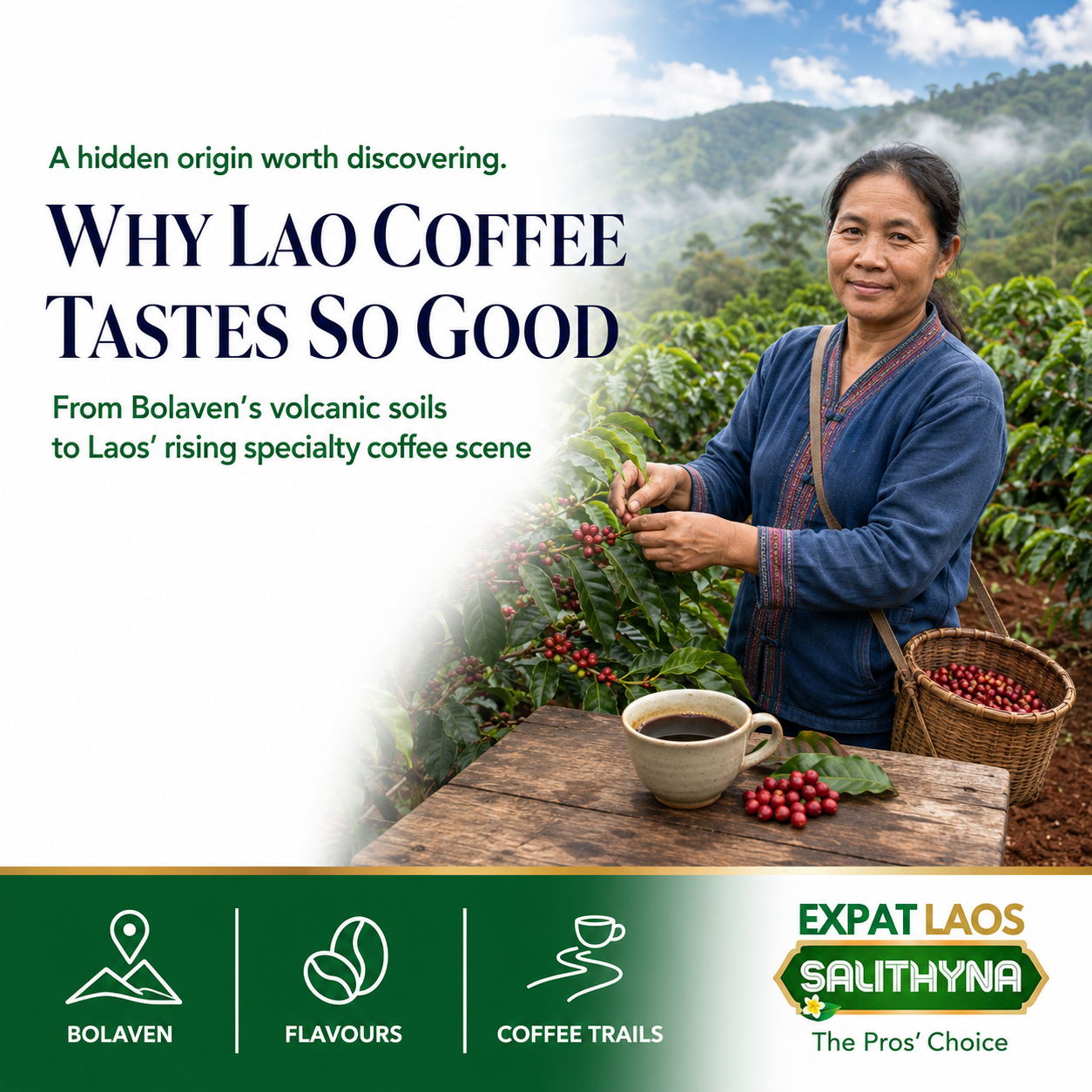
Lao coffee deserves a larger place on the specialty map. Its best-known origin, the Bolaven Plateau in southern Laos, combines elevation, a cool wet climate and red volcanic soils. Add careful harvesting and processing, and the result can be sweet, aromatic Arabica or powerful, chocolate-toned Robusta — often at a quality level that surprises first-time drinkers.
This guide explains what makes coffee from Laos distinctive, which beans to choose, where to experience the country’s coffee culture and how to buy a bag that rewards the producer as well as the drinker.
⚡ THE DIRECT ANSWER
Lao coffee tastes distinctive because the Bolaven Plateau offers favourable growing conditions: altitude, cooler temperatures, regular rainfall and mineral-rich volcanic soils. Arabica usually brings aroma, sweetness and brighter acidity; Robusta brings body, cocoa-like depth and intensity. Origin matters, but process, roast and freshness decide what finally reaches the cup.
1. Why does Bolaven Plateau coffee taste so good?
The Bolaven Plateau, centred around Paksong in Champasak Province, is Laos’ coffee heartland. Tourism Laos describes high-elevation growing areas reaching roughly 1,300 metres and a landscape shaped by volcanic soils, cool temperatures and substantial rainfall. Those conditions slow development and support the raw material for more complex cups; the producer’s work determines whether that potential is realised.
- Elevation and cooler nights can support slower cherry development and a more structured flavour profile.
- Volcanic basaltic soils and regular rainfall create favourable growing conditions, without guaranteeing a particular flavour on their own.
- Selective picking, clean fermentation, careful drying and storage protect sweetness and clarity after harvest.
- Fresh, appropriate roasting preserves origin character; very dark roasting can hide it.
Sources: Lao Coffee: A Journey Through Flavor & Heritage • Champasak Province and the Bolaven Plateau • Bolaven Coffee and Paksong Tea geographical indications
2. Arabica or Robusta: what should you choose?
Both species belong in a serious Lao coffee guide. The right choice depends on how you brew and what you enjoy, not on a simple hierarchy of “better” and “worse.” Flavour varies by variety, farm, process, roast and freshness.
| Bean | Common cup direction | Best match |
|---|---|---|
| Arabica | Aromatic, often sweet and bright; chocolate, citrus or floral notes may appear in well-handled lots. | Filter coffee, lighter espresso and drinkers seeking clarity. |
| Robusta | Fuller body, lower perceived acidity and a more forceful cocoa, nut or bittersweet profile. | Traditional Lao iced coffee, espresso and blends needing structure. |
3. Is Lao coffee more than the Bolaven Plateau?
Bolaven is the established reference, but northern Laos is part of the next chapter. Projects in Houaphanh and other upland areas have supported organic and specialty coffee as an alternative livelihood and an agroforestry crop. AFD has described northern Laos as a region with meaningful future potential rather than a finished success story; that distinction matters. Northern lots should be judged on traceability and cup quality, not on novelty alone.
Sources: From opium to organic coffee in Houaphanh • Sustainable natural-resource management in Laos
4. Why does Lao coffee matter economically?
Coffee is already a material export, not merely a tourism souvenir. World Bank WITS data based on UN Comtrade record Lao coffee exports under HS 0901 at about US$95.1 million and 37.3 million kilograms in 2023. Vietnam and Thailand were the two largest recorded destinations by value, followed by Cambodia and Belgium. These figures describe the 2023 trade category; they are not a forecast for 2026.
The strategic opportunity is to sell more value, not only more volume. International Trade Centre programmes have focused on quality control, traceability, export readiness and specialty-market access. When a clearly identified Lao lot earns a premium, more of the origin story — and potentially more income — can stay close to producers.
Sources: Lao coffee exports, 2023 • Lao coffee producers on the road to grow exports • Higher prices for specialty coffee
5. Where can you experience coffee in Laos?
☕ Paksong and the Bolaven Plateau
Pakse is the practical gateway; Paksong is the coffee hub. A focused day can include a plantation or processing visit, a guided tasting and one or two waterfalls such as Tad Fane or Tad Yeuang. Tourism Laos presents coffee visits and waterfall stops as a natural combination. Operators, opening hours and road conditions change, so confirm locally before departure. While in Champasak, you can also add a visit to Vat Phou, the province’s UNESCO temple.
☕ Vientiane
The capital is the easiest place to compare several Lao origins without travelling to a farm. Choose cafés or roasters that identify the province, variety or species, process and roast date. Ask for the same coffee as espresso and filter if available; the comparison quickly reveals body, sweetness and acidity.
☕ Pakse and Luang Prabang
Pakse connects the growing region to travellers, while Luang Prabang offers an accessible café setting in which to discover Lao beans. Use both cities as tasting points, then look beyond décor: a credible menu or retail bag should tell you where the coffee came from and how recently it was roasted.
📍 Coffee trip at a glance
| Step | What to know |
|---|---|
| Base | Pakse, then travel to Paksong and the Bolaven Plateau |
| Best context | The harvest period is commonly described as roughly November to March; verify timing with the farm |
| Ask | Origin, species or variety, process, harvest, roast date and who produced it |
| Buy | Whole beans in a sealed bag, roasted recently and labelled with useful traceability |
| Check | Current opening hours, tour availability, weather and road conditions |
Sources: Coffee tourism in Champasak • Champasak Province and the Bolaven Plateau
6. How do you buy good Lao coffee?
A strong label answers useful questions. It does not need luxury language; it needs evidence.
📋 Buyer’s checklist
- Look for a named origin — ideally a province, plateau, village, cooperative or farm.
- Prefer a clear roast date over a vague best-before date; buy whole beans if you can grind at home.
- Match roast and species to your brew: lighter Arabica for clarity, or Robusta and blends for body and intensity.
- Treat the Bolaven Coffee geographical indication as origin protection, not a substitute for freshness or good processing.
- Reward traceability: producers and roasters who identify the lot make quality easier to evaluate and repeat.
Source: Bolaven Coffee and Paksong Tea geographical indications
7. What are the challenges behind the opportunity?
The story is promising but not frictionless. Climate variability, pests, uneven post-harvest practice and limited market access can reduce both quality and producer income. Sustainable expansion also depends on water, soil, shade and land-management choices. The most credible future for Lao specialty coffee therefore links better flavour with resilient farming, reliable traceability and fairer value capture.
Sources: Sustainable natural-resource management in Laos • Lao coffee producers on the road to grow exports
❓ Frequently asked questions
Is Laos known for coffee?
Yes. Laos is an established coffee-producing country, with the Bolaven Plateau as its best-known origin. International visibility remains smaller than production and quality potential, which is why Lao coffee can still feel like a discovery.
What is special about Bolaven Plateau coffee?
The plateau combines elevation, a cooler wet climate and volcanic basaltic soils. Those growing conditions, plus careful picking, processing and roasting, can produce aromatic Arabica and full-bodied Robusta.
Is Arabica or Robusta better in Laos?
Neither is automatically better. Choose Arabica for fragrance, sweetness and brighter acidity; choose Robusta for weight, cocoa-like intensity and traditional Lao iced-coffee or espresso styles.
Where can I visit a coffee plantation in Laos?
Start from Pakse and travel toward Paksong on the Bolaven Plateau. Confirm visits directly or through a local operator because access, schedules and harvest activity vary.
When is the coffee harvest season in Laos?
The main Bolaven harvest is commonly described as running from around November to March, with timing varying by altitude, species and season. Ask the farm before planning a harvest-focused visit.
Is Bolaven Coffee protected?
Yes. Bolaven Coffee is registered as a Lao geographical indication. The GI protects origin and reputation; buyers should still check the producer, process, roast date and freshness.
8. The bottom line
Lao coffee is worth seeking out because it offers more than one profile and more than one story. Bolaven gives the country a strong, protected origin; Arabica and Robusta offer genuinely different pleasures; and emerging northern projects widen the map. The best way to understand it is simple: taste a traceable lot, ask who produced it, and — if you can — visit the landscape behind the cup.
Last verified: 4 September 2026. Tour schedules, opening hours, harvest timing and road conditions change: confirm locally before travelling.
🔗 Continue exploring Laos
🌿 Discover Laos with Expat Laos SALITHYNA
Explore Laos with clear, locally grounded guidance from Expat Laos SALITHYNA — from food and travel to housing, relocation and everyday life. Discover our services. expatlaos-salithyna.com
By Clem-Titsada, co-founder of Salithyna Group. Franco-Lao and based in Vientiane, she has been developing professional services since 2022 that meet international standards and fit the realities of Laos.