
 by
by 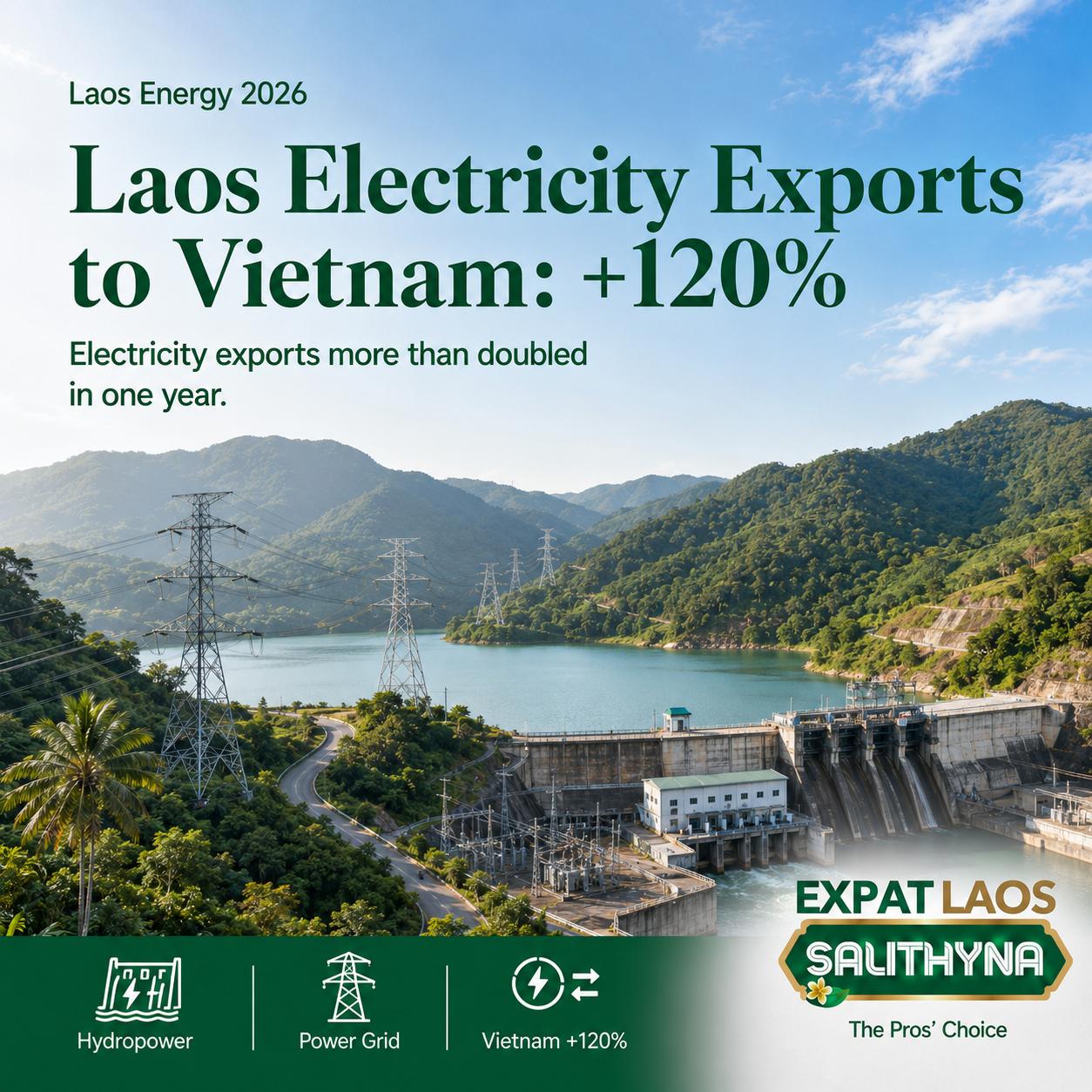
Laos is strengthening its position as a regional energy and logistics hub in Southeast Asia.
Electricity exports to Vietnam surged by nearly 120% year-on-year in the first quarter of 2026, while new road, rail and energy infrastructure is gradually transforming the country’s role within regional supply chains.
For companies, entrepreneurs and investors operating in Laos, these developments go far beyond the energy sector.
They are creating new perspectives for import-export, logistics, warehousing, real estate, distribution and business services.
Laos Electricity Exports to Vietnam Rise Nearly 120%
Electricity trade between Laos and Vietnam accelerated sharply at the beginning of 2026.
Vietnam imported approximately 2.92 billion kilowatt-hours of electricity from Laos during the first quarter of 2026, compared with around 1.33 billion kWh during the same period in 2025.
+120%
Year-on-year growth in electricity exports from Laos to Vietnam
This represents a record level of electricity transmission between the two countries and highlights the increasingly strategic role Laos plays in supplying energy to neighbouring economies.
Often described as the “Battery of Southeast Asia”, Laos has developed significant hydropower resources and cross-border electricity infrastructure connecting the country with Thailand, Vietnam, Cambodia and the wider ASEAN energy market.
47 Lao Energy Projects Approved to Supply Vietnam
Cooperation between Laos and Vietnam extends far beyond today’s electricity flows.
By the end of 2025, Vietnam had approved plans to import electricity from 47 power projects located in Laos.
8,260 MW
Combined capacity of approved Lao energy projects
Approximately 2,379 MW of this capacity is already connected and commercially supplying the Vietnamese electricity grid.
This indicates that current electricity exports may represent only part of the future energy relationship between the two countries.
Vietnam’s growing economy requires increasing amounts of electricity, while Laos possesses major hydropower and renewable-energy resources close to the Vietnamese market.
The result is a growing structural connection between:
- Laos’s energy production capacity
- Vietnam’s industrial and economic growth
Xekaman 4: Another Energy Project Dedicated to Vietnam
The Lao government has also formalised a concession for the Xekaman 4 Hydropower Project in Sekong Province.
The project will have an installed capacity of approximately:
80 MW
Its electricity production is intended entirely for export to Vietnam.
Although smaller than some of Laos’s major hydropower developments, Xekaman 4 demonstrates an important trend.
Energy infrastructure in Laos is increasingly being developed around regional demand rather than domestic consumption alone.
For Laos, electricity exports provide foreign-currency revenues while strengthening economic integration with its neighbours.
Beyond Energy: A New Laos–Vietnam Economic Corridor
Energy is only one part of the transformation.
Transport connectivity between Laos and Vietnam is also improving significantly.
In May 2026, Vietnam officially began construction of the approximately 60-kilometre Vinh–Thanh Thuy Expressway in Nghe An Province.
The road will connect Vietnam’s expressway network with the Lao border and forms part of the broader Vientiane–Hanoi transport corridor.
Development is also progressing on the Lao side of the planned route.
The long-term objective is strategically important:
Create a faster and more efficient road connection between Vientiane, central Vietnam and Hanoi.
For businesses in Laos, this could eventually provide improved access to Vietnamese industrial centres, transport infrastructure and maritime gateways.
From Landlocked to Land-Linked
For decades, Laos’s geography was primarily considered an economic disadvantage.
The country has no direct access to the sea and is surrounded by larger neighbouring economies.
Today, this geography is increasingly becoming an opportunity.
Laos is positioning itself as a land-linked country, connecting some of Asia’s most dynamic markets.
Its strategic location places it between:
- China
- Thailand
- Vietnam
- Cambodia
- Myanmar
The opening of the Laos–China Railway was a major step in this transformation.
New road infrastructure toward Vietnam adds another important axis.
For companies operating from Vientiane, the regional map is becoming increasingly strategic:
- North – China
- West – Thailand
- East – Vietnam and access toward its ports
- South – Cambodia
Laos is gradually becoming a junction between several major Southeast Asian economic corridors.
What Does This Change for Companies Operating in Laos?
The expansion of energy exports and regional infrastructure has implications well beyond electricity production.
1. Import–Export Opportunities
Improved regional connectivity can progressively reduce some of the challenges associated with transporting goods into and out of Laos.
Companies operating in sectors such as:
- Construction materials
- Industrial equipment
- Food and beverages
- Consumer products
- Automotive products
- Machinery
- Furniture
- Professional equipment
may benefit from more diversified supply and distribution routes.
Vietnam could increasingly become an alternative or complementary gateway alongside Thailand and China.
2. Logistics and Warehousing
Growing cross-border trade naturally creates demand for supporting infrastructure.
This may include:
- Warehouses
- Distribution centres
- Freight forwarding
- Customs services
- Transportation
- Cold storage
- Industrial property
- Regional distribution
Vientiane’s position at the intersection of emerging regional transport corridors makes logistics and warehousing particularly important sectors to watch.
3. Commercial and Industrial Real Estate
Infrastructure development also creates indirect demand.
International companies entering or expanding in Laos may require:
- Offices
- Employee accommodation
- Warehouses
- Commercial premises
- Industrial space
- Land
- Long-term housing for expatriate teams
This can generate new opportunities across the Vientiane real estate market, particularly in areas benefiting from improved regional connectivity.
4. New Opportunities for Foreign Companies
Better regional infrastructure changes the way companies can evaluate the Lao market.
Laos should not necessarily be viewed only as a domestic market.
Its strategic value increasingly comes from its position within the Greater Mekong Subregion.
For some companies, the key question may therefore evolve from:
“How large is the Lao domestic market?”
to:
“Which regional markets can we reach from Laos?”
That difference can completely change an investment strategy.
Laos Is Becoming Part of Regional Supply Chains
The emerging economic model is increasingly based on connectivity.
The Laos–China Railway provides a major northbound corridor.
Road infrastructure connects Vientiane with Thailand and the Mekong economic area.
New projects toward Vietnam strengthen access to the east.
Cross-border electricity infrastructure connects Laos directly with the growing energy requirements of neighbouring countries.
Together, these developments are gradually integrating Laos into regional:
- Energy networks
- Transportation corridors
- Supply chains
- Distribution systems
- Industrial networks
What Investors Should Watch in Laos
Infrastructure alone does not automatically create investment opportunities.
Companies considering entering Laos should continue to evaluate regulatory requirements, taxation, licensing, foreign ownership rules, labour availability and local operating conditions.
However, several sectors deserve particular attention in 2026 and beyond:
- Electricity and renewable energy
- Laos–Vietnam economic integration
- Laos–China Railway freight development
- Logistics
- Warehousing
- Industrial property
- Commercial real estate
- Cross-border distribution
- Import-export
- Infrastructure services
- Business support services
The broader trend is clear:
Laos should increasingly be analysed not only as a domestic market, but as a strategic location connecting some of Southeast Asia’s largest economies.
Doing Business in Laos – Local Knowledge Remains Essential
Better infrastructure makes Laos more attractive, but successfully operating in the country still requires strong local knowledge.
Administrative procedures, property searches, company services, local suppliers, recruitment and everyday operational requirements can differ significantly from neighbouring markets.
For foreign companies and entrepreneurs, understanding the local environment can make the difference between simply entering the market and establishing a sustainable operation.
Salithyna Group – Local Expertise. International Standards.
Salithyna Group is based in Vientiane and supports international companies, entrepreneurs, investors and expatriates operating in Laos.
Our activities include:
- Real estate and property search
- Corporate relocation
- Expatriate relocation
- Business support services
- Local market assistance
- Import-export support
- Assistance for companies establishing operations in Laos
Our approach combines local knowledge with international standards, helping our clients navigate the practical realities of living, investing and doing business in Laos.
Planning to Establish or Expand Your Business in Laos?
Discover our services and local expertise.
Frequently Asked Questions
Is Laos a major electricity exporter?
Yes. Laos produces significant amounts of hydropower and exports electricity to neighbouring countries, particularly Thailand and Vietnam.
Electricity exports to Vietnam reached approximately 2.92 billion kWh during the first quarter of 2026.
How much did Laos electricity exports to Vietnam increase in 2026?
Electricity exports from Laos to Vietnam increased by approximately 120% year-on-year during the first quarter of 2026.
Why is Laos becoming strategically important for regional trade?
Laos is geographically positioned between China, Thailand, Vietnam, Cambodia and Myanmar.
New railways, expressways, energy infrastructure and border connections are gradually transforming the country from a landlocked economy into a regional transport and logistics corridor.
Is Laos becoming a regional logistics hub?
Laos is progressively developing this role.
The Laos–China Railway, improved road connections with Thailand and new infrastructure toward Vietnam are strengthening the country’s position within Greater Mekong regional trade routes.
Is Vientiane a good location for doing business in Laos?
Vientiane is the country’s principal administrative and commercial centre.
It hosts government institutions, embassies, international organisations, foreign companies and a large share of Laos’s international business activity.
Its proximity to Thailand and its connections with regional transport corridors also strengthen its strategic position.
What sectors could benefit from improved Laos–Vietnam connectivity?
Several sectors may benefit, including:
- Logistics
- Warehousing
- Import-export
- Construction
- Energy
- Industrial services
- Commercial real estate
- Transportation
- Distribution
- Professional business services
SALITHYNA GROUP
Real Estate • Relocation • Business Services • Import–Export
Vientiane, Laos
Feels Like Home