 by
by 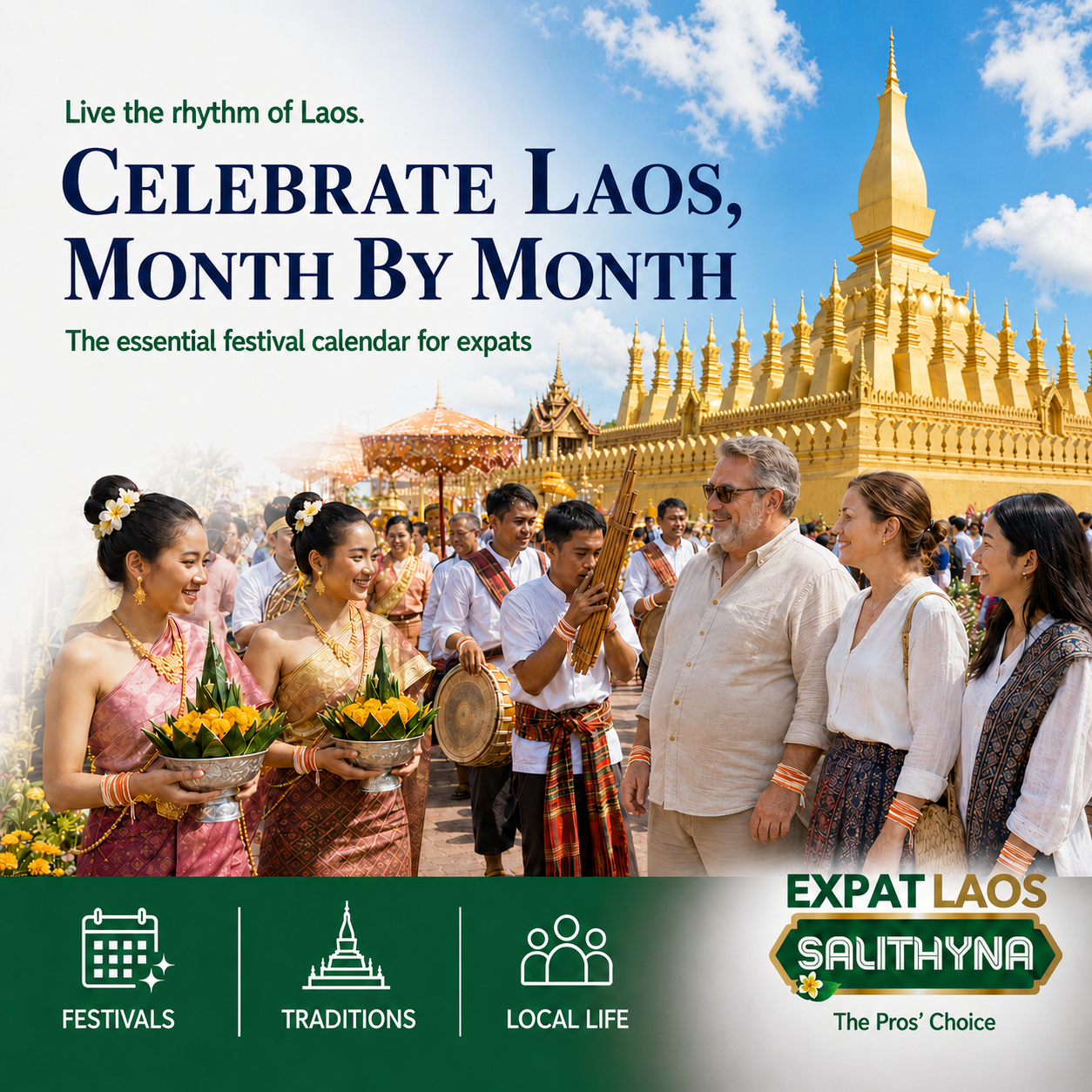
The timing of this guide is deliberate. As of September 2026, Laos is entering its richest festival season: the end of Buddhist Lent and the Vientiane boat races in late October 2026, the immense That Luang Festival in November 2026, National Day on 2 December, then Hmong New Year — before the cycle culminates with Pi Mai, the Lao New Year, in April 2027.
Most Lao festivals follow the Buddhist lunar calendar, so their dates shift every year — which is exactly why expats get caught out. This article gives you the verified dates for 2026 and 2027, what actually happens at each festival, how daily life is affected, and the codes of conduct that make the difference between a welcome guest and an embarrassing one.
⚡ QUICK ANSWER
As of September 2026, the next major festivals in Laos are: Boun Ok Phansa (end of Buddhist Lent) on 26 October 2026, followed by the Vientiane boat racing festival on 27 October 2026 and the illuminated boats of Lai Heua Fai the same night; the That Luang Festival in Vientiane around the full moon of 24 November 2026; and Lao National Day on 2 December 2026. The biggest festival of all, Boun Pi Mai (Lao New Year), falls on 14–16 April 2027. Expect office closures, full hotels and heavy traffic around each of these dates.
📋 7 Key Takeaways
- Most Lao festivals follow the Buddhist lunar calendar: their dates change every year, so always check the current year before planning.
- Boun Pi Mai (Lao New Year, 14–16 April 2027) is the most important festival of the year — three official days, city-wide water fights, and closures that can stretch to a week.
- The That Luang Festival (around 24 November 2026) is the largest religious gathering in Laos, drawing hundreds of thousands of pilgrims to Vientiane’s golden stupa.
- The boat races (Boun Souang Heua, 27 October 2026 in Vientiane) are the most accessible and family-friendly festival for expats — free, festive and spectacular.
- During major festivals, government offices, banks and many businesses close for several days, and hotels in Vientiane and Luang Prabang sell out weeks in advance.
- Temple etiquette is non-negotiable: shoulders and knees covered, shoes off, and never pour water on monks or the elderly during Pi Mai.
- Hmong New Year is celebrated in December–January, after the harvest — one of the most colourful and welcoming celebrations near Vientiane and Luang Prabang.
📊 The Lao festival year in figures
| Indicator | Figure |
|---|---|
| Official public holidays | Around 10 national holidays per year |
| Major festivals | 8 to 12 significant events per year, varying by region |
| Reference calendar | Buddhist lunar calendar — most dates shift every year |
| Next big date | Boun Ok Phansa: 26 October 2026, boat races 27 October 2026 |
| That Luang Festival 2026 | Full moon of 24 November 2026, trade fair the week before |
| Boun Pi Mai 2027 | 14–16 April 2027 (celebrations in Luang Prabang often run longer) |
1. How does the Lao festival calendar work — and why does it matter for expats?
Laos celebrates two kinds of holidays. Fixed civil dates, such as National Day on 2 December, never move. Buddhist festivals — the majority — are set by the lunar calendar, usually on full-moon days, so they land on different dates each year. That is why Boun Ok Phansa falls on 26 October in 2026 but on 15 October in 2027, and why any festival guide without a year attached to its dates should be treated with caution.
The practical impact on daily life in Laos is real. During major festivals, ministries, banks and many private businesses close — from one day for minor holidays to most of a week around Pi Mai. Hotels in Vientiane fill up three to four weeks before the That Luang Festival, and Luang Prabang sells out even earlier for Lao New Year. Traffic around festival sites becomes dense, and alcohol sales are occasionally restricted on major Buddhist days. None of this is a problem if you plan for it; all of it is a headache if you discover it the morning of.
Laos is a deeply Buddhist country of the Theravada tradition, and its festivals are not staged for tourists — they are the living heart of Lao community life. That is precisely what makes them worth attending: an expatriate who has stood in the candlelit crowd at That Luang or been soaked head to toe at Pi Mai understands something about Laos that no guidebook can teach.
2. Which festivals are coming up next, from October to December 2026?
🔹 Boun Ok Phansa — the end of Buddhist Lent (26 October 2026)
Boun Ok Phansa closes the three-month Buddhist Lent (Phansa), the annual rains retreat during which monks stay in their temples for study and meditation. According to the holiday calendar published by Office Holidays, it falls on Monday 26 October 2026. The day begins with dawn almsgiving and temple ceremonies; the evening belongs to Boun Lai Heua Fai, when families release small boats decorated with flowers, candles and incense onto the Mekong to carry away misfortune. The sight of hundreds of glowing boats drifting downriver at night is one of the most beautiful things you will see in Laos.
🔹 The boat races — Boun Souang Heua (27 October 2026 in Vientiane)
The day after Ok Phansa, Vientiane holds its great boat racing festival on the Mekong — a national holiday listed for Tuesday 27 October 2026 by Office Holidays. Traditional racing pirogues, some carved from a single tree trunk and crewed by 30 to 50 rowers, compete over roughly two kilometres of river in front of enormous crowds along Quai Fa Ngum. Luang Prabang runs its own races on the Nam Khan river. Expect a special night market, live music and food stalls along the whole riverfront.
📋 The most expat-friendly festival of the year
No strict dress code, a family atmosphere, food everywhere, music, and a spectacular show that costs nothing: the boat races are the easiest first Lao festival for a newly arrived expatriate. Our advice from experience — arrive on the quay early in the morning to claim a good viewing spot, bring sun protection, and stay for the evening when the illuminated boats of Lai Heua Fai take over the river.
🔹 Boun That Luang — the great national festival (around 24 November 2026)
The That Luang Festival is the largest religious gathering in Laos and the symbol of Lao national identity. It takes place around Pha That Luang, the gold-covered stupa that appears on the national seal, and culminates on the full moon of the twelfth lunar month — Tuesday 24 November in 2026, per Office Holidays. Hundreds of thousands of pilgrims converge on Vientiane over three days for candlelit processions, mass almsgiving to monks, and wax-castle offerings. The week before, a huge trade fair sets up around the stupa: silk weaving, wood carving, silver jewellery, provincial food specialities and concerts every evening. If you want to understand what the monument means to the country, our article on the history of Pha That Luang tells the full story.
⚠️ Book Vientiane early for That Luang week
Hotels in central Vientiane are typically full three to four weeks before the That Luang Festival, and traffic around the stupa district is very dense for the whole festival week. If you expect visitors in late November 2026, have them book accommodation by the end of October. This is observed practice from previous editions, not an official rule.
🔹 Lao National Day (2 December) and Hmong New Year (December–January)
National Day on 2 December is a fixed public holiday commemorating the proclamation of the Lao People’s Democratic Republic in 1975. Expect official ceremonies, flags on every building and closed administrations — a quiet day rather than a street party. A few weeks later comes one of the most joyful celebrations of the year: Hmong New Year (Noj Peb Caug), celebrated in December or January after the harvest, with exact dates varying by district, as documented by Rove.me. Expect magnificent embroidered costumes, the traditional pov pob ball-tossing game between young men and women, bullfights in some villages, and outstanding Hmong food. Several sites in Vientiane province and around Luang Prabang welcome visitors warmly.
3. What are the major festivals of 2027, month by month?
🔹 January–February 2027: harvest gratitude and candlelit full moons
Boun Khoun Khao, the harvest festival, is celebrated in villages in January–February to thank the spirits of the rice fields. It is rural, intimate and almost invisible in central Vientiane — but if you are invited to a village celebration, accept: it is Lao hospitality at its most authentic.
Boun Makha Busa (Magha Puja), on the February full moon — 21 February in 2027 — commemorates the spontaneous gathering of 1,250 disciples around the Buddha. In the evening, worshippers circle their temple three times with candles, flowers and incense. It is the most serene and photogenic Buddhist ceremony of the year for a respectful observer. The same full-moon period is when Champasak celebrates Boun Vat Phou, at the UNESCO-listed Khmer temple of Vat Phou in southern Laos: candlelit processions up the ancient stairway, offerings, and festivities at the foot of the mountain — well worth a long weekend from Vientiane or Pakse.
🔹 April 2027: Boun Pi Mai, the festival that stops the country (14–16 April)
Boun Pi Mai, the Lao New Year, is without question the most important festival in Laos. It falls at the hottest time of the year, on 14–16 April 2027 for the three official days, though celebrations in Luang Prabang traditionally stretch longer with masked processions, sand stupas on the Mekong beaches and the solemn bathing of revered Buddha images. The Lao version of the water festival remains more spiritual than its Thai and Cambodian cousins: pouring scented water is, at its origin, a blessing of purification — the city-wide water battle grew out of that gesture.
Practically, Pi Mai is the week to plan around. Government offices and many businesses close for three to five days, intercity transport is packed, and Luang Prabang accommodation sells out weeks — sometimes months — in advance. The Vientiane–Luang Prabang leg of the Laos–China Railway takes about two hours, and flights about one hour, but both fill quickly for the holiday. If you are choosing where to experience your first Pi Mai, our comparison of Vientiane vs. Luang Prabang will help you decide.
⚠️ Pi Mai survival rules
During Pi Mai, the streets of Vientiane and Luang Prabang become a giant water battle. Carry your phone and wallet in a waterproof pouch, assume you will be soaked whenever you step outside, and never pour water on monks, the elderly, or anyone driving a moving vehicle — the first two are serious cultural offences, the third is genuinely dangerous. These rules are taken seriously by Lao people, and respecting them is the price of joining the fun.
🔹 May–July 2027: rockets, then retreat
Boun Bang Fai, the rocket festival, arrives in May or June, mainly in rural districts of Vientiane province, Khammouane and the south. Villages compete to launch enormous home-made bamboo rockets skyward to call the rains, amid brass bands, satirical dances and generous amounts of Beerlao. It is loud, hilarious and gloriously chaotic — the perfect excuse for a weekend out of the capital, earplugs recommended.
Boun Khao Phansa, on the July full moon, opens the next three-month Buddhist Lent. Monks return to their temples, weddings pause, and the country enters its quieter, more inward season — a beautiful period for early-morning temple visits, and the signal that the festival cycle described in this article is about to begin again.
🔹 The complete festival calendar, October 2026 – July 2027
| Festival | Dates | Where | For the expat |
|---|---|---|---|
| Boun Ok Phansa | 26 October 2026 | Nationwide | End of Lent, illuminated boats at night |
| Boat races (Boun Souang Heua) | 27 October 2026 | Vientiane (Mekong), Luang Prabang (Nam Khan) | The most festive, family-friendly day of the year |
| That Luang Festival | Around 24 November 2026 | Vientiane | Largest gathering in Laos — book hotels early |
| Lao National Day | 2 December 2026 (fixed) | Nationwide | Official holiday, offices closed |
| Hmong New Year | December 2026 – January 2027 | Vientiane province, Luang Prabang, Xieng Khouang | Costumes, games, superb food |
| Boun Khoun Khao | January–February 2027 | Villages | Harvest gratitude — go if invited |
| Boun Makha Busa | 21 February 2027 | Temples nationwide | Candlelit processions, serene |
| Boun Vat Phou | February 2027 (full moon) | Champasak (UNESCO site) | Ideal long weekend in the south |
| Boun Pi Mai (Lao New Year) | 14–16 April 2027 | Nationwide, peak in Luang Prabang | The big one — plan everything early |
| Boun Bang Fai | May–June 2027 | Rural provinces | Rocket festival — loud and joyful |
| Boun Khao Phansa | July 2027 (full moon) | Nationwide | Start of Lent — the quiet season |
4. How should you behave at Lao festivals and in temples?
Joining Lao celebrations is a privilege that comes with clear rules. Laos is a profoundly Buddhist society, and breaches of temple etiquette — even unintentional ones — genuinely hurt people. The good news: the rules are few, simple, and applying them earns you visible goodwill everywhere.
🔹 The essential do’s and don’ts
| What to do | What to avoid |
|---|---|
| Cover shoulders and knees in temples | Entering a temple in shorts or a tank top |
| Remove your shoes before entering temple buildings | Public displays of physical affection |
| Ask permission before photographing monks | Pouring water on monks or the elderly at Pi Mai |
| Join offerings if invited to | Drinking alcohol inside temple grounds |
| Greet with the nop (palms joined) | Pointing your feet toward an altar or a person |
| Stay calm and patient — “bo pen nyang” | Raising your voice or losing your temper in public |
Two of these deserve emphasis because expats get them wrong most often. First, the dress code: shoulders and knees covered is the minimum in any temple, festival day or not — keep a light scarf or sarong in your bag. Second, monks: women should never touch a monk or hand him anything directly, and nobody should ever aim water at one during Pi Mai. Everything else is forgiven with a smile; these are not.
5. What does cultural life in Vientiane offer the rest of the year?
Between festivals, Vientiane has a quieter but real cultural life for expats who want more than the event calendar. The Lao National Theatre stages classical Lao dance and pha lak pha lam — the Lao telling of the Ramayana — with regular performances and tickets in the 5–15 USD range. It is the single best evening for understanding the stories behind the festivals you will attend.
The museum circuit is compact and worthwhile: the Lao National Museum for history and archaeology; Wat Si Saket, the oldest surviving temple in Vientiane, with its cloister walls holding more than 6,800 Buddha images; Hor Phra Keo, the former royal temple turned museum of religious art; and the COPE Visitor Centre, a moving, free exhibition on the victims of unexploded ordnance — sobering, and essential for understanding modern Laos.
For daily culture, the markets do the work: Talat Sao (the Morning Market) for silk, silver and textiles, and the Mekong riverside night market every evening. In Luang Prabang, the dawn tak bat ceremony — hundreds of monks in saffron robes collecting alms along the main street — remains one of the most beautiful daily rituals in Southeast Asia; observe it quietly, from a respectful distance, without flash. And festival food is its own reason to attend everything: our guide to the 5 must-try dishes in Vientiane will make sure you know what to order at the stalls.
6. The bottom line: plan around the festivals — then dive in
The Lao festival calendar rewards the expatriate who treats it as a rhythm to join rather than an obstacle to schedule around. Note the four dates that structure the year ahead — the boat races on 27 October 2026, That Luang around 24 November 2026, Pi Mai on 14–16 April 2027, and whichever village festival you get invited to — book anything involving Luang Prabang early, keep a scarf in your bag, and say yes to invitations. An expatriate who has lived Pi Mai in Luang Prabang, cheered the pirogues on the Mekong and walked the candlelit esplanade of That Luang has understood something essential about this country — and made memories that outlast any posting.
🌿 Planning your move to Laos?
Expat Laos SALITHYNA helps expatriates settle, rent, buy and invest in Vientiane — including planning arrivals and housing around the realities of the festival calendar. Discover our services and local expertise. expatlaos-salithyna.com
WhatsApp: +856 20 57 935 574 — Email: contact@salithynagroup.com
❓ Frequently asked questions
What is the most important festival in Laos?
Boun Pi Mai, the Lao New Year, is the most important festival in Laos. It falls in mid-April — 14–16 April in 2027 — and combines Buddhist purification rituals with nationwide water fights. Government offices and many businesses close for three to five days, and Luang Prabang, the most spectacular place to experience it, sells out weeks in advance.
When is the That Luang Festival in 2026?
The That Luang Festival 2026 culminates around the full moon of Tuesday 24 November 2026, at the Pha That Luang stupa in Vientiane, with a large trade fair running the week before. It is the biggest religious gathering in Laos, drawing hundreds of thousands of pilgrims, so book Vientiane accommodation three to four weeks ahead.
When are the boat races in Vientiane in 2026?
The Vientiane boat racing festival (Boun Souang Heua) takes place on Tuesday 27 October 2026, the day after Boun Ok Phansa ends Buddhist Lent on 26 October. Races run on the Mekong along Quai Fa Ngum, with a night market and concerts, and the illuminated boats of Lai Heua Fai are released on the river the night of Ok Phansa.
Do businesses and offices really close during Lao festivals?
Yes. Government offices, banks and many private businesses close on official holidays — typically one day for minor festivals, and three to five days around Pi Mai in April. Hotels in festival cities fill up well in advance, and traffic near festival sites becomes very dense. International schools generally follow their own calendars, so check both.
What should I wear to a temple or a Buddhist festival?
Shoulders and knees must be covered for both men and women, and shoes come off before entering temple buildings. A light scarf or sarong kept in your bag solves most situations. Avoid touching monks — women in particular should never hand anything directly to a monk — and never point your feet toward an altar.
Can foreigners take part in Lao festivals?
Yes, and participation is genuinely welcomed. Expats join the water fights at Pi Mai, watch the boat races, walk in candlelit processions and shop the That Luang fair alongside Lao families. The only conditions are respectful dress, restraint around monks and elders, and following the lead of the people around you.
Why do Lao festival dates change every year?
Because most Lao festivals follow the Buddhist lunar calendar, usually falling on full-moon days, their dates shift by days or weeks from one year to the next. Boun Ok Phansa, for example, falls on 26 October 2026 but 15 October 2027. Only civil holidays such as National Day on 2 December are fixed. Always verify dates for the current year before booking travel.
📚 Sources and fact-check references
- Office Holidays — Lao public holiday calendar: That Luang Festival, Boun Ok Phansa, Boat Racing Festival (consulted September 2026)
- Lao National Tourism authority (tourismlaos.org) — festival descriptions
- Rove.me — Hmong New Year in Laos, December–January timing
- UNESCO World Heritage listing — Vat Phou, Champasak
- Expat Laos SALITHYNA — on-the-ground observations from festival seasons in Vientiane
Last updated September 2026. Festival dates for 2026–2027 were verified against public holiday calendars at the time of writing; lunar dates can be adjusted by the authorities, so re-check close to each event. Cultural guidance reflects official custom and observed practice, identified as such.
🔗 Continue exploring life and business in Laos
- 🇱🇦 10 Things to Do in Laos: Explore the Land of a Million Elephants — the essential experiences to pair with your festival calendar, from Vang Vieng to the 4,000 Islands.
- April in Laos: Tropical Fruits During Pii Mai — what to eat during Lao New Year, when the markets overflow with mango, rambutan and durian.
- Vietnamese and Chinese New Year in Laos — the other new years celebrated in Laos, and how expats can join them.
- Gastronomy: 5 must-try dishes in Vientiane in 2026 — know exactly what to order at the festival food stalls.
- Moving to Laos in 2026: The Complete Relocation Checklist — plan your arrival around the festival calendar with the full step-by-step checklist.
By Clem-Titsada, co-founder of Salithyna Group. Franco-Lao and based in Vientiane, she has been developing professional services adapted to international standards and to the realities of Laos since 2022.