
 by
by 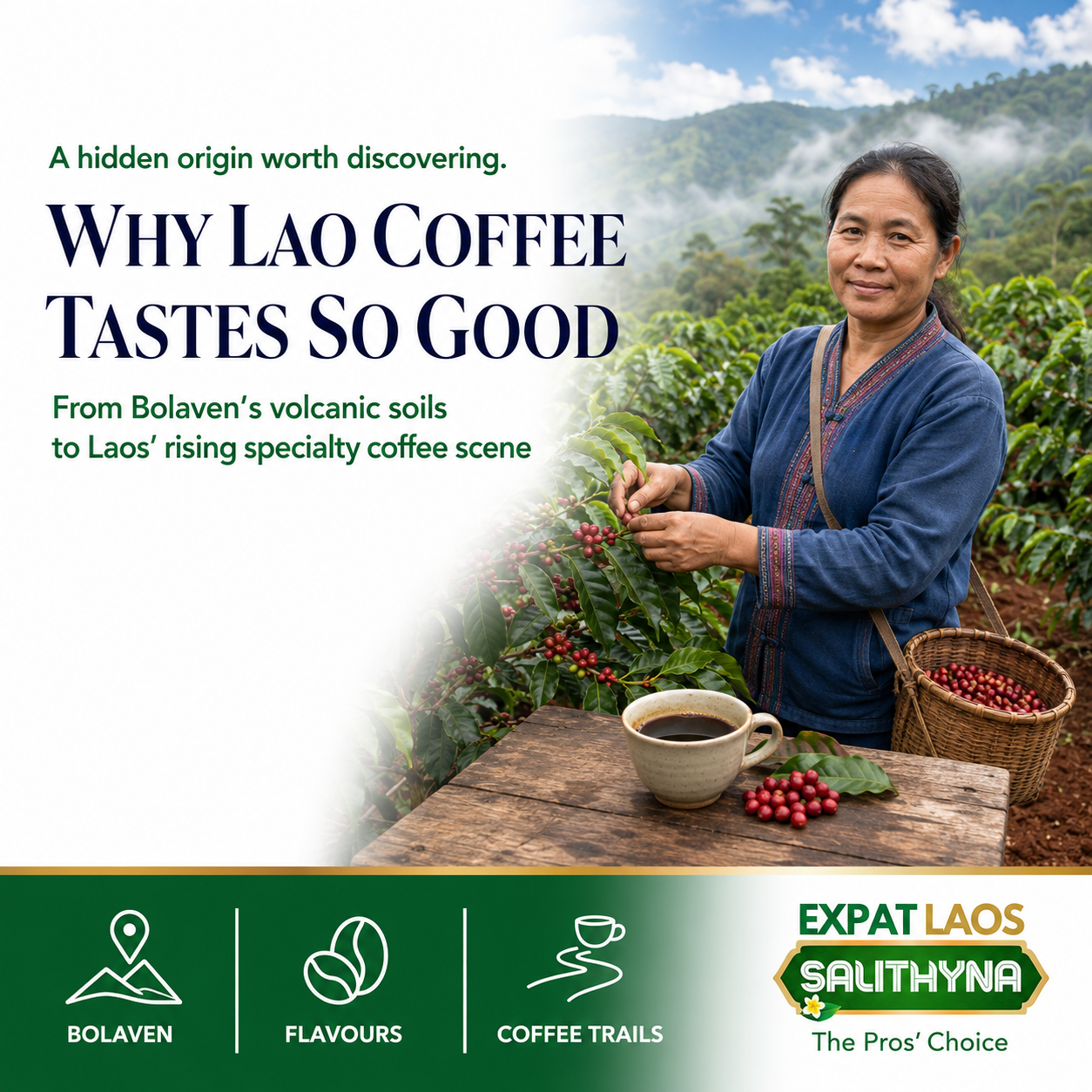
Lao coffee deserves a larger place on the specialty map. Its best-known origin, the Bolaven Plateau in southern Laos, combines elevation, a cool wet climate and red volcanic soils. Add careful harvesting and processing, and the result can be sweet, aromatic Arabica or powerful, chocolate-toned Robusta — often at a quality level that surprises first-time drinkers.
The economics are less romantic and more interesting. Laos exported about USD 95.1 million of coffee in 2023, and more than three quarters of that value went to just two neighbours, Vietnam and Thailand, mostly as green beans that are roasted, blended and sold under someone else’s label. The opportunity for Laos is not to grow more coffee. It is to keep more of the story, and more of the value, attached to the origin.
This guide explains what makes coffee from Laos distinctive, which beans to choose, where to experience the country’s coffee culture, and how to buy a bag that rewards the producer as well as the drinker.
⚡ QUICK ANSWER
Lao coffee tastes distinctive because the Bolaven Plateau, in Champasak Province, offers favourable growing conditions: altitudes between 800 and 1,350 metres, cooler temperatures, regular rainfall and mineral-rich volcanic soils. Arabica usually brings aroma, sweetness and brighter acidity; Robusta brings body, cocoa-like depth and intensity. Bolaven Coffee has been a registered Lao geographical indication since 2020. Origin matters, but process, roast and freshness decide what finally reaches the cup — so buy on roast date and traceability, not on the plateau’s name alone.
📋 7 Key Takeaways
- The Bolaven Plateau, centred on Paksong in Champasak Province, produces the large majority of Lao coffee, at altitudes of 800 to 1,350 metres.
- Laos grows both species: roughly three quarters Robusta and one quarter Arabica, which is why a single national flavour profile does not exist.
- Lao coffee exports reached about USD 95.1 million and 37.3 million kilograms in 2023, with Vietnam and Thailand taking around 78% of the value.
- Bolaven Coffee and Paksong Tea were registered as Lao geographical indications in 2020.
- Northern Laos is the next chapter, not the current story: the Vanmai cooperative in Houaphanh exported 19 tonnes to France in 2021 after switching from opium.
- The main harvest on the Bolaven Plateau runs from roughly November to March, which is also the best travelling window.
- A useful coffee label names the origin, the species, the process and the roast date; a geographical indication alone guarantees none of those.
📊 Lao coffee in figures
| Indicator | Figure | Source and date |
|---|---|---|
| Coffee exports, HS 0901 | USD 95.1 million, 37.3 million kg | World Bank WITS / UN Comtrade, 2023 |
| Largest destination | Vietnam, USD 48.7 million | World Bank WITS / UN Comtrade, 2023 |
| Second destination | Thailand, USD 25.7 million | World Bank WITS / UN Comtrade, 2023 |
| Bolaven Plateau altitude | 800 to 1,350 metres | Lao Coffee Association |
| Geographical indication | Bolaven Coffee registered in 2020 | ERIA, Branding Strategy in Lao PDR |
| Main harvest | November to March | Tourism Laos, Champasak coffee tourism |
1. Why does Bolaven Plateau coffee taste so good?
The Bolaven Plateau, centred around Paksong in Champasak Province, is the coffee heartland of Laos. According to the Lao Coffee Association, the plateau rises between 800 and 1,350 metres, on volcanic soils, with cool temperatures and morning mist — one of the few places in the world where high-grown Robusta and premium Arabica are both at home. Those conditions slow cherry development and supply the raw material for a more complex cup. The producer’s work then decides whether that potential is realised.
Four factors decide what reaches your cup, and only the first is geography.
- Elevation and cooler nights support slower cherry development and a more structured flavour profile.
- Volcanic basaltic soils and regular rainfall create favourable growing conditions, without guaranteeing a particular flavour on their own.
- Selective picking, clean fermentation, careful drying and storage protect sweetness and clarity after harvest.
- Fresh, appropriate roasting preserves origin character; very dark roasting hides it.
That last point is where most disappointment happens. A bag labelled Bolaven and roasted eight months ago will taste of the roast, not of the plateau.
2. Arabica or Robusta: which Lao coffee should you choose?
Neither is automatically better, and both belong in a serious guide to Lao coffee. Laos produces roughly three times more Robusta than Arabica, so a visitor who tastes only one species has not tasted the country. The right choice depends on how you brew and what you enjoy, and flavour varies by variety, farm, process, roast and freshness far more than by species label.
☕ Choosing between the two species
| Bean | Common cup direction | Best match |
|---|---|---|
| Arabica | Aromatic, often sweet and bright; chocolate, citrus or floral notes appear in well-handled lots | Filter coffee, lighter espresso, drinkers seeking clarity |
| Robusta | Fuller body, lower perceived acidity, forceful cocoa, nut or bittersweet profile | Traditional Lao iced coffee, espresso, blends needing structure |
The most useful experiment in Laos costs nothing: order the same coffee as an espresso and as a filter in the same café. Body, sweetness and acidity separate immediately, and you learn more in ten minutes than any tasting note can teach.
3. Is Lao coffee only from the Bolaven Plateau?
No. Bolaven remains the established reference and the large majority of national production, but northern Laos is part of the next chapter. In Houaphanh Province, the Vanmai cooperative — supported since 2016 by the UNODC and by the International Trade Centre through the ARISE Plus Lao PDR project — helped former opium-growing communities switch to organic coffee. The ITC case study records close to 400 farmers trained across 12 villages, more than 19 tonnes exported to France in 2021, and a Fairtrade licence obtained since.
That is a meaningful beginning, not a finished market. Nineteen tonnes is a rounding error beside the 37.3 million kilograms Laos exported in 2023. Northern lots deserve attention on traceability and cup quality, not on novelty alone — and the honest framing is emerging potential rather than an established second origin.
4. Why does Lao coffee matter economically?
Coffee is a material export, not a tourism souvenir. World Bank WITS data drawn from UN Comtrade record Lao coffee exports under HS 0901 at about USD 95.1 million and 37.3 million kilograms in 2023. Vietnam took USD 48.7 million of that, Thailand USD 25.7 million, Cambodia USD 5.5 million and Belgium USD 4.2 million. These figures describe the 2023 trade category; they are not a forecast for 2026.
💵 Where Lao coffee went in 2023
| Destination | Value | Share of total value |
|---|---|---|
| Vietnam | USD 48.7 million | about 51% |
| Thailand | USD 25.7 million | about 27% |
| Cambodia | USD 5.5 million | about 6% |
| Belgium | USD 4.2 million | about 4% |
| All other markets | about USD 11 million | about 12% |
Read that table again, because it is the whole strategic problem in five rows. Around 78% of Lao coffee value in 2023 crossed a land border into Vietnam or Thailand, largely as green beans that are then roasted, blended and sold under another country’s name. The opportunity is to sell more value, not only more volume. International Trade Centre programmes have concentrated on quality control, traceability, export readiness and specialty-market access for exactly that reason: when a clearly identified Lao lot earns a premium, more of the origin story — and potentially more income — stays close to the producers.
5. Where can you experience coffee in Laos?
🔹 Paksong and the Bolaven Plateau
Pakse is the practical gateway; Paksong is the coffee hub. A focused day can combine a plantation or processing visit, a guided tasting and one or two waterfalls — Tourism Laos presents Tad Fane and Tad Yeuang as the natural stops alongside coffee visits, and gives the harvest window as November to March. Operators, opening hours and road conditions change, so confirm locally before departure. The same trip pairs naturally with Vat Phou, the UNESCO temple of Champasak, an hour south of Pakse.
🔹 Vientiane
The capital is the easiest place to compare several Lao origins without travelling to a farm. Choose cafés or roasters that identify the province, variety or species, process and roast date. Vientiane’s coffee scene sits alongside a food culture worth exploring in its own right, covered in our guide to the five dishes to try in Vientiane.
🔹 Pakse and Luang Prabang
Pakse connects the growing region to travellers, while Luang Prabang offers an accessible café setting in which to discover Lao beans. Use both cities as tasting points, then look beyond the décor: a credible menu or retail bag tells you where the coffee came from and how recently it was roasted. Anyone considering a longer stay in the south will find the practical detail in our guide to moving to Pakse or Vang Vieng.
🗺️ Planning a Bolaven coffee trip
| Planning item | What to do |
|---|---|
| Base | Pakse, then travel up to Paksong and the Bolaven Plateau |
| Best timing | The harvest runs roughly November to March; verify with the farm before booking |
| Questions to ask | Origin, species or variety, process, harvest, roast date and who produced it |
| What to buy | Whole beans, sealed bag, recently roasted, with real traceability on the label |
| What to check | Current opening hours, tour availability, weather and road conditions |
6. How do you buy good Lao coffee?
A strong label answers useful questions. It does not need luxury language; it needs evidence.
- Look for a named origin — ideally a province, plateau, village, cooperative or farm.
- Prefer a clear roast date over a vague best-before date, and buy whole beans if you can grind at home.
- Match roast and species to your brew: lighter Arabica for clarity, Robusta or blends for body and intensity.
- Treat the Bolaven Coffee geographical indication as origin protection, not as a substitute for freshness or good processing.
- Reward traceability: producers and roasters who identify the lot make quality easier to evaluate and to find again.
⚠️ What a geographical indication does and does not do
Bolaven Coffee and Paksong Tea were registered as Lao geographical indications in 2020, managed by dedicated promotion associations in Champasak Province. A geographical indication protects where a product comes from and the reputation attached to that place. It says nothing about the roast date in front of you, the care taken during fermentation and drying, or how the bag was stored. Check those separately, every time.
7. What are the challenges behind the opportunity?
The story is promising but not frictionless. Climate variability, pests, uneven post-harvest practice and limited market access can reduce both quality and producer income. Sustainable expansion also depends on water, soil, shade and land-management choices, and a plateau that is asked to produce more each year without those choices will produce worse coffee, not better. The most credible future for Lao specialty coffee links better flavour with resilient farming, reliable traceability and fairer value capture — the same three conditions the ITC programmes have worked on since 2016.
🌿 Discovering Laos beyond the guidebook?
Expat Laos SALITHYNA offers clear, locally grounded guidance on Laos — from food, coffee and travel to housing, relocation and everyday life in Vientiane. Discover our services and local expertise. expatlaos-salithyna.com
WhatsApp: +856 20 57 935 574 — Email: contact@salithynagroup.com
❓ Frequently asked questions
Is Laos known for coffee?
Yes. Laos is an established coffee-producing country and exported about USD 95.1 million of coffee in 2023, with the Bolaven Plateau as its best-known origin. International visibility remains far smaller than production and quality potential, largely because most beans leave as unbranded green coffee. That gap is why Lao coffee still feels like a discovery.
What is special about Bolaven Plateau coffee?
The plateau combines altitudes of 800 to 1,350 metres, a cooler wet climate and volcanic basaltic soils, according to the Lao Coffee Association. Those growing conditions, plus careful picking, processing and roasting, can produce aromatic Arabica and full-bodied Robusta. It is also one of the few regions in the world where both species grow well.
Is Arabica or Robusta better in Laos?
Neither is automatically better. Choose Arabica for fragrance, sweetness and brighter acidity; choose Robusta for weight, cocoa-like intensity and traditional Lao iced-coffee or espresso styles. Laos produces roughly three times more Robusta than Arabica, so tasting only Arabica gives an incomplete picture of the country.
Where can I visit a coffee plantation in Laos?
Start from Pakse and travel toward Paksong on the Bolaven Plateau, where plantation visits, processing tours and tastings are concentrated. Confirm visits directly with the farm or through a local operator, because access, schedules and harvest activity vary. Tad Fane and Tad Yeuang waterfalls are the usual companions on the same day trip.
When is the coffee harvest season in Laos?
The main Bolaven harvest runs from around November to March, according to Tourism Laos, with timing varying by altitude, species and season. That window also coincides with the dry season, which makes the plateau roads easier. Ask the farm directly before planning a harvest-focused visit.
Is Bolaven Coffee protected?
Yes. Bolaven Coffee was registered as a Lao geographical indication in 2020, alongside Paksong Tea, each managed by a dedicated promotion association in Champasak Province. The GI protects origin and reputation. Buyers should still check the producer, process, roast date and freshness, which a GI does not cover.
Where does Lao coffee actually go?
Vietnam and Thailand took around 78% of Lao coffee export value in 2023 — USD 48.7 million and USD 25.7 million respectively — with Cambodia and Belgium next. Most of it crosses the border as green beans and is roasted and blended elsewhere. That is precisely why so little coffee reaches the consumer labelled as Lao.
📚 Sources and fact-check references
- World Bank WITS / UN Comtrade — Lao PDR coffee exports, HS 0901, 2023
- Lao Coffee Association — Bolaven Plateau origin profile, altitude and species
- Tourism Laos — coffee tourism in Champasak, harvest season and waterfall itineraries
- International Trade Centre — From opium to organic coffee: the Vanmai cooperative in Houaphanh
- ERIA — Branding Strategy in Lao PDR, geographical indications registered in 2020
Last updated September 2026. Trade figures use the 2023 dataset, the latest comparable public year, and are labelled as such rather than presented as current-year values. Tour schedules, opening hours, harvest timing and road conditions change and should be verified locally before travelling.
🔗 Continue exploring life and travel in Laos
- Laos Festivals 2026–2027: The Complete Cultural Calendar for Expats — the dry season that suits the coffee harvest is also festival season, and the calendar decides when roads and farms are busy.
- 10 Things to Do in Laos: Explore the Land of a Million Elephants — where a Bolaven coffee day fits inside a wider trip through the country.
- Vientiane vs. Luang Prabang: Which City Should You Choose as an Expat? — the two cities where you will do most of your tasting, compared for daily life.
- Laos Airports: The Complete 2026 Guide for Expats — how to reach Pakse for the plateau, and what each airport actually offers.
- Cost of Living in Laos: A Guide for Expats — what a café habit, and everything else, actually costs once you stay.
By Clem-Titsada, co-founder of Salithyna Group. Franco-Lao and based in Vientiane, she has been developing professional services adapted to international standards and to the realities of Laos since 2022.



Join The Discussion