
 by
by 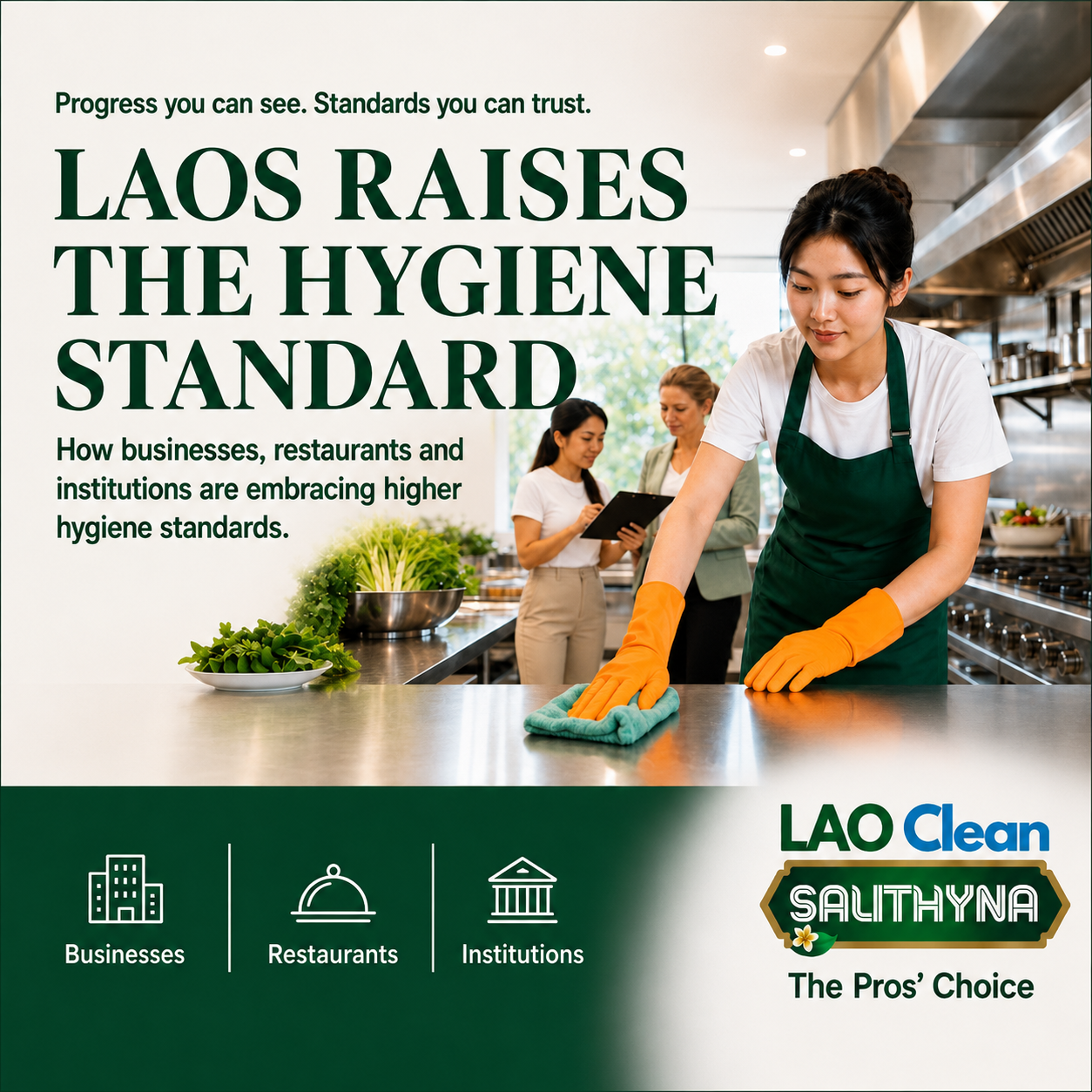
📋 6 Key Takeaways
- Laos already has a legal framework on food safety: the Law on Food (amended in 2013) governs production, storage and distribution, and inspections of food businesses are provided for.
- A surface can look clean while still carrying grease and invisible micro-organisms: true hygiene distinguishes between removing dirt, cleaning, degreasing and disinfecting.
- The HACCP method (Hazard Analysis and Critical Control Points) is a preventive approach derived from the FAO/WHO Codex Alimentarius — not simply more intensive cleaning.
- The tropical climate of Laos — heat, humidity, seasonal dust — calls for specific protocols: mould, rapid soiling of floors and deteriorating joints do not wait.
- Three forces are driving hygiene forward in Laos: a better-trained new generation, a returning diaspora with international standards, and businesses exposed to a global clientele.
- A good provider is recognised by its ability to propose a clear method, proportionate to the risk, after a technical site visit — not by its price.
1. What sanitary regulations apply in Laos?
Laos already has a legal framework dedicated to food safety, hygiene and consumer protection — sanitary safety is not a recently imported concept; it is one of the country’s official priorities.
⚖️ What Lao law provides
The Lao Law on Food, amended in 2013, requires that the production, storage, packaging and distribution of food respect hygiene and safety principles. Food packaging and containers must be suitable and present no risk of contamination.
The national food safety policy covers the entire chain:
| Stage | What is covered |
|---|---|
| Production | Food production and processing |
| Logistics | Storage, transport, import and export |
| Trade | Distribution and sale |
| Service | Catering and service to the consumer |
The country also has an inspection system for food businesses, designed to protect consumers against dangerous or contaminated food.
💡 The current challenge is not the existence of the rules, but their day-to-day application: team training, traceability of operations and consistency of good practice.
Sources: Lao PDR National Food Safety Policy; Law on Food, amended in 2013; Decision on Food Inspection.
2. Why are hygiene practices improving in Laos?
The progress observed does not rest on a single factor. Three transformations reinforce one another.
🎓 A better-trained new generation
More and more young Lao people are studying, learning professional methods and moving into positions of responsibility. In hotels, restaurants, schools and the health sector, this rise in skills translates into more structured procedures. Cleaning is no longer treated as a purely visual task: professionals understand the difference between removing dirt, cleaning a surface, degreasing it, disinfecting it and preventing new contamination.
🌏 The return of the diaspora
Members of the Lao diaspora are returning to live, work or invest in Laos, bringing experience gained in France, Australia, the United States, Canada and elsewhere in Asia. These backgrounds spread new habits in organisation, training and health prevention.
⚠️ Success does not mean mechanically copying a foreign model: procedures must be adapted to the climate, the buildings, the equipment available and the operational realities of Laos.
🌍 Businesses exposed to international standards
The growth of tourism, foreign investment and international organisations is transforming expectations. An office, restaurant or school serving an international clientele must meet precise requirements: visible quality of the premises, well-maintained washrooms, odour control, rigorous treatment of kitchens and regular quality checks. This movement is no longer limited to the high end of the market — it is spreading across the whole sector.
3. Restaurant hygiene in Laos: why appearance is not enough
In a restaurant, a surface can look clean while still carrying grease, residue or invisible micro-organisms. Good hygiene therefore cannot rely on appearance alone.
🍽️ The 8 critical zones of a professional kitchen
| Zone | Main risk |
|---|---|
| Work surfaces | Direct contact with food |
| Cooking equipment | Cooked grease and residue |
| Hoods and filters | Grease build-up, incident risk |
| Cold rooms | Stock contamination |
| Floors, joints, drains | Bacteria and invisible soiling |
| Handles and switches | Frequently touched contact points |
| Washrooms | Staff and customers |
| Waste areas | Pests and odours |
Regular, methodical cleaning simultaneously protects customers, staff, the establishment’s reputation and its equipment: less accumulated grease, fewer bad odours, fewer pests and fewer incident risks.
4. What is the HACCP method?
HACCP stands for Hazard Analysis and Critical Control Points. It is not more intensive cleaning: it is a preventive method that identifies risks, pinpoints critical control points and puts appropriate checks in place. Its principles come from the FAO/WHO Codex Alimentarius and are embedded in European food hygiene requirements.
Applied to cleaning, the HACCP logic involves:
- identifying areas presenting a sanitary risk;
- preventing cross-contamination;
- using products suited to each surface;
- respecting dosages and contact times;
- separating equipment by zone;
- establishing a cleaning frequency;
- checking execution and keeping a record of interventions where necessary.
LaoClean Salithyna works to a method aligned with HACCP hygiene principles and European best practice, adapted to the conditions encountered in Laos.
⚠️ Important: HACCP primarily concerns the overall control of food safety. A cleaning company contributes to that control, but it replaces neither the restaurant’s internal HACCP plan nor the legal obligations of its operator.
5. The Lao climate calls for specific protocols
Procedures applied in Laos must take the tropical climate into account. Heat, humidity, seasonal dust and intense rain encourage mould, persistent odours, rapid soiling of floors, bacterial growth on certain surfaces, deterioration of joints and porous materials, and insects entering food areas.
💡 In Vientiane, an effective cleaning programme is built around the building, its footfall, its ventilation and its activity. The same protocol cannot be applied indiscriminately to a villa, a school, a kitchen, an office or an institutional building.
🏢 Different needs for different clients
| Type of site | Priorities |
|---|---|
| Houses and villas | Kitchens, washrooms, windows, terraces, damp areas — and a full pre-move-in clean for expatriates |
| Offices and companies | Regularity, contact points, shared spaces, without disrupting business |
| Restaurants and kitchens | Technical protocol: degreasing, zoning, prevention of cross-contamination |
| Schools and institutions | Reliable organisation, supervised teams, regular checks for high daily footfall |
LaoClean Salithyna works with private households, large companies, schools, institutions and public-sector buildings in Vientiane.
6. How to recognise a professional cleaning company in Laos
Before choosing a provider in Vientiane, check that it can clearly explain: which products will be used, which areas will be treated, how tasks will be distributed, how teams will be supervised, how final quality will be checked, and how contamination between washrooms, kitchens and shared spaces will be avoided.
Price matters, but it is not enough to judge a service. A very low rate often means a purely visual pass — no protocol, no suitable equipment, no quality control.
💡 The real indicator is the provider’s ability to propose a clear method, proportionate to the risk — and that always starts with a technical site visit.
Our Approach
This is the conviction behind LaoClean Salithyna: the development of Laos must go hand in hand with a lasting improvement in service quality. The country has committed professionals, teams eager to learn and businesses already investing in better practices. Our role is to contribute to this movement by combining knowledge of the Lao field, training and supervision of teams, protocols inspired by HACCP principles and regular quality control. You will find full details of our services at expatlaos-salithyna.com.
Conclusion: hygiene, an investment in trust
In Laos, sanitary regulations and cleanliness practices are moving in an encouraging direction. The regulations exist. Skills are improving. Businesses are professionalising. New generations and the diaspora are contributing to this transformation. The next step: making good practice more consistent, better documented and accessible to more establishments.
For a restaurant, a company, a school or an institution, investing in professional cleaning is not just about improving the appearance of the premises. It protects people, extends the life of installations and strengthens the trust placed in the establishment.
🔑 5 Keys to Success
- Know your obligations: Lao law governs food safety and provides for inspections — check the requirements applicable to your activity with the competent authorities.
- Do not judge on appearance: clean does not mean healthy; the difference between cleaning, degreasing and disinfecting protects your customers and your reputation.
- Adapt to the climate: heat and humidity impose specific frequencies and protocols in Laos.
- Demand a method: products, zones, supervision, quality control — a serious provider can answer these questions before starting.
- Start with a technical site visit: it determines the method, equipment and frequency your site really needs.
Looking for a professional cleaning company in Vientiane? LaoClean Salithyna supports private households, restaurants, companies, schools and institutions with solutions adapted to each environment. Contact our team via expatlaos-salithyna.com to arrange a technical visit and receive a tailored proposal.
Frequently asked questions about hygiene and cleaning in Laos
Are there sanitary regulations for restaurants in Laos?
Yes. Lao legislation governs the quality and safety of food, its preparation, storage, transport and distribution. Inspections of food businesses are also provided for.
Is the HACCP method mandatory for all businesses in Laos?
Exact obligations depend on the activity and the regulations applicable to the establishment. HACCP is above all an international method for preventing food risks; every professional should verify their obligations with the competent authorities.
What is the difference between cleaning and disinfection?
Cleaning removes dirt and residue from a surface. Disinfection reduces micro-organisms using a suitable product and method. Effective disinfection generally needs to be preceded by proper cleaning.
How often should a professional kitchen be cleaned?
Frequency depends on activity and risk level. Some surfaces are treated after every service, while hoods, technical areas and deep cleans follow a separate schedule defined during the technical visit.
Does LaoClean Salithyna only work with private households?
No. LaoClean Salithyna works in villas and residences, but also with offices, companies, restaurants, schools, institutions and public buildings in Vientiane.
How do I request an assessment in Vientiane?
A technical visit examines the surfaces, sensitive areas, access constraints and desired frequency. LaoClean Salithyna then proposes a programme adapted to the building and its use.
By Clémence, co-founder of Salithyna Group and LaoClean Salithyna. Franco-Lao and based in Vientiane, she has been developing professional services adapted to international standards and to the realities of Laos since 2022.