 by
by 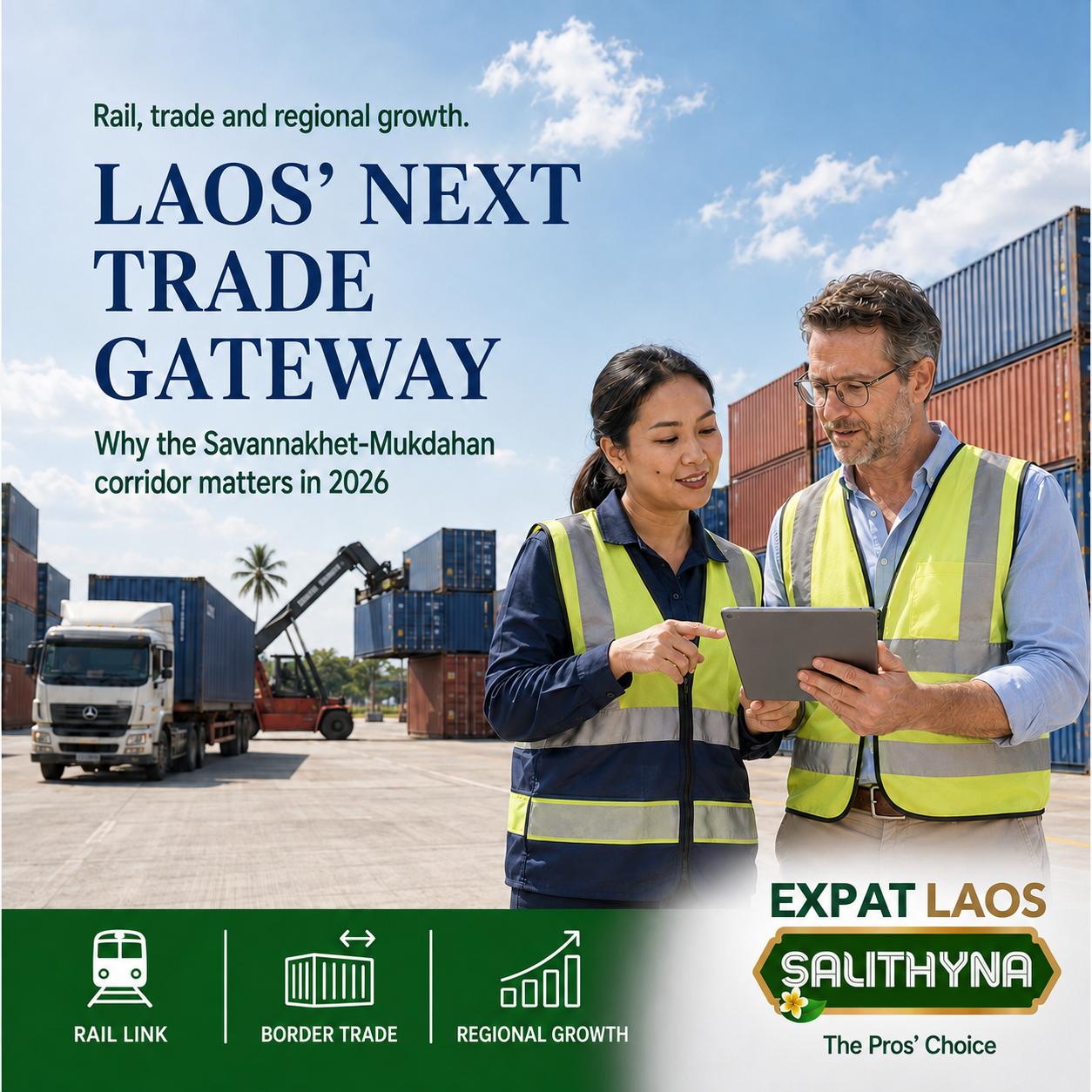
Following the opening of the Laos–China Railway and the development of logistics facilities around Vientiane, another project is taking shape in the south of the country: an operational connection between Savannakhet Dry Port and Thailand’s emerging railway infrastructure in Mukdahan.
The objective is to create an integrated logistics chain combining rail, road, customs facilities, warehousing and the existing dry port.
If implemented efficiently, the system could improve cargo flows between Thailand, Laos and Vietnam, while also linking indirectly with logistics networks serving southern China.
The proposal may sound technical, but its longer-term consequences could extend well beyond transport.
It could influence industrial investment, employment, cross-border trade, commercial property and the development of Savannakhet as a regional business centre.
⚠️ THE KEY POINT
Savannakhet Dry Port already operates in Laos. The new proposal is to connect it operationally with Mukdahan railway infrastructure through a rail-to-road transfer and the Second Thai–Lao Friendship Bridge. No direct cross-border railway between Mukdahan and Savannakhet is currently open.
📋 6 Key Takeaways
- On 14 August 2026, a Thai Senate Transport Committee delegation visited Savannakhet to examine a logistics link between Mukdahan and Savannakhet Dry Port.
- No railway crosses the Mekong yet: freight would arrive by rail on the Thai side, then transfer to trucks over the Second Thai–Lao Friendship Bridge.
- Savannakhet Dry Port is already operating — run by Savan Logistics since 2016 and acquired by DP World in May 2024.
- The complex covers 140,456 m² in Zone C of the Savannakhet Special Economic Zone, alongside Savan Park SEZ.
- Thailand’s Ban Phai–Mukdahan–Nakhon Phanom double-track railway (~355 km) is the missing piece on the Thai side.
- For expatriates there is no immediate change; the medium-term effect concerns jobs, business services and accommodation demand in Savannakhet.
📊 Savannakhet Dry Port–Mukdahan: Key Figures
| Indicator | Figure |
|---|---|
| Dry port surface | 140,456 m² (approx. 23,000 m² of warehousing) |
| In operation since | 2016, Zone C of the Savannakhet SEZ |
| Operator | Savan Logistics — acquired by DP World in May 2024 |
| Thai railway under construction | Ban Phai–Mukdahan–Nakhon Phanom, ~355 km, double track |
| Corridor | East–West Economic Corridor (EWEC), Da Nang → Myawaddy |
| Border crossing | Second Thai–Lao Friendship Bridge (road) |
1. What Was Announced?
On 14 August 2026, a delegation from the Transport Committee of the Thai Senate visited Savannakhet to examine cross-border trade, transport connectivity and logistics infrastructure between Thailand and Laos.
The delegation was led by Wutthichat Kalyanamitr, Chairman of the Committee on Transport.
Its members visited Savan Park Special Economic Zone and Savannakhet Dry Port, where they met representatives of Savan Logistics and Savan Park.
The discussions focused on the possibility of linking Mukdahan railway infrastructure with the dry port and industrial zone in Savannakhet. The proposal was reported by Vientiane Times on 18 August 2026.
Under the proposed logistics chain, cargo would move through the following sequence:
- Thai railway network
- Mukdahan railway container yard or terminal
- Transfer from train to truck
- Mukdahan border facilities
- Second Thai–Lao Friendship Bridge
- Savannakhet Dry Port and Savan Park SEZ
- Road connections towards Vietnam and wider regional logistics networks
This model would bring transport, storage, customs and redistribution into a more coordinated multimodal system instead of treating each road and border operation as a separate stage.
2. An Important Clarification: The Link Is Not Yet Open
The announcement does not describe a new railway line already crossing the Mekong between Mukdahan and Savannakhet.
In the system currently being discussed, freight would arrive by rail on the Thai side.
Containers would then be transferred to trucks, cross the Second Thai–Lao Friendship Bridge and continue to Savannakhet Dry Port.
The proposal is therefore a rail–road–dry port connection, not — at this stage — a direct trans-Mekong railway.
No official opening date has been announced for the complete Mukdahan–Savannakhet logistics chain.
3. What Is a Dry Port?
A dry port is an inland logistics terminal connected to one or more transport modes.
According to the United Nations ESCAP definition, it can handle, store and inspect internationally traded goods while supporting customs controls and formalities.
In practical terms, it performs many of the functions associated with a seaport without directly loading cargo onto ocean-going ships.
A dry port can provide:
- Container and cargo storage
- On-site customs clearance and inspection
- Bonded warehousing
- Cargo consolidation and distribution
- Transfers between road and rail
- Container tracking and digital logistics services
- Domestic and international freight forwarding
This allows part of the customs and logistics process to take place inland, reducing the need to repeat every operation at a distant maritime port or at multiple border points.
4. Savannakhet Dry Port Is Already Operating
Savannakhet Dry Port is not a new facility being built from the ground up.
Savan Logistics has operated the site since 2016 in Zone C of the Savannakhet Special Economic Zone.
In May 2024, international logistics group DP World completed its acquisition of Savan Logistics, giving the existing platform a broader international logistics network.
140,456 m²
Total surface of the Savannakhet Dry Port complex, including approximately 23,000 m² of warehousing, of which around 11,000 m² is bonded space.
DP World also manages cross-border transport, freight forwarding and integrated logistics services at the site.
The significance of the new proposal therefore lies not in creating a dry port for Savannakhet, but in connecting an existing facility more effectively to Thailand’s developing rail network.
5. Why Is Savannakhet Strategically Located?
Savannakhet sits on the East–West Economic Corridor, commonly known as the EWEC.
This major mainland route links commercial areas in Vietnam, Laos, Thailand and Myanmar.
The Greater Mekong Subregion programme describes the corridor as running from Da Nang in Vietnam through Laos and Thailand towards Myanmar. Key nodes include Lao Bao, Dansavanh, Savannakhet, Mukdahan, Khon Kaen, Phitsanulok, Mae Sot and Myawaddy.
Within Laos, National Road 9 crosses the country from the Vietnamese border at Dansavanh to Savannakhet and the Second Thai–Lao Friendship Bridge.
Until now, most attention has focused on Vientiane as the country’s strategic hub; Savannakhet occupies a different and complementary position on the map.
This places Savannakhet at the intersection of several strategic assets:
- An international east–west road corridor
- A direct border crossing with Thailand
- Overland access to Vietnam and its seaports
- Savan Park Special Economic Zone
- An operating dry port with customs and warehousing facilities
- Potential access to Thailand’s railway network through Mukdahan
6. Mukdahan’s Future Railway Connection
Thailand is constructing a new double-track railway between Ban Phai, Mukdahan and Nakhon Phanom.
The route is approximately 355 kilometres long and is intended to connect several north-eastern provinces with the national rail network.
For Mukdahan, which has not previously had a complete rail connection of this kind, the project is expected to create new passenger and freight capacity.
A 2025 public target referred to an opening ambition of 2028, with potential annual demand of more than 3.8 million passengers and approximately 700,000 tonnes of freight.
The timetable should, however, be treated cautiously.
The official Contract 1 project website reported 61.076% construction progress as of 9 August 2026 and lists 1 November 2029 as the revised contract completion date for the Ban Phai–Nong Phok section.
That date applies to one construction contract rather than automatically defining the opening date of the full line.
It nevertheless shows why the overall railway and the Mukdahan logistics connection remain subject to scheduling changes.
7. How Could the Connection Reshape Logistics in Laos?
A large share of freight moving through Savannakhet currently depends on road transport.
Containers may pass through several border, customs and handling stages, creating delays and operational uncertainty.
A connection with the Thai railway network could allow larger cargo volumes to move over long distances by rail before completing the cross-border stage by truck.
Savannakhet Dry Port could then act as the central point for receiving containers, performing customs procedures, storing goods and redistributing cargo within Laos or towards Vietnam.
This could improve the regularity and coordination of regional freight movements. It may also reduce some breaks in the logistics chain.
Lower transport costs or faster delivery times cannot yet be guaranteed.
Actual results will depend on rail tariffs, train frequency, cargo volumes, border efficiency, customs procedures, transfer times and the operating capacity of the bridge and terminal facilities.
8. A Regional Project Beyond Laos–Thailand Trade
The proposal is not limited to moving goods between Mukdahan and Savannakhet.
Its strategic purpose is to support a wider multimodal axis involving:
- Thailand
- Laos
- Vietnam and its maritime gateways
- Regional logistics routes leading towards southern China
From Savannakhet, cargo could continue east along National Road 9 towards the Vietnamese border, then move through Vietnamese industrial centres, ports and other regional corridors.
The China connection would therefore be regional and indirect.
This fits a wider pattern of Laos–Vietnam economic integration, already visible in the sharp rise in Lao electricity exports to Vietnam recorded in early 2026.
The August 2026 proposal does not announce a new direct railway from Savannakhet to China.
9. What Opportunities Could Emerge in Savannakhet?
If the logistics connection is implemented and attracts sufficient cargo volume, Savannakhet could draw more activity related to transport, storage and light industrial processing.
Potential beneficiary sectors include:
- Warehousing and distribution
- Packaging and cargo consolidation
- Cold-chain logistics
- Vehicle, container and equipment maintenance
- Customs brokerage and trade documentation
- Import-export services
- Manufacturing and assembly activities
The proximity of Savan Park SEZ and Savannakhet Dry Port may be attractive to companies that want to import materials from Thailand, manufacture or assemble products in Laos and export them to neighbouring markets.
Over time, this could support demand for industrial land, offices, employee accommodation, restaurants, shops and business services.
These are medium- to long-term possibilities, not guaranteed immediate outcomes.
10. What Could the Project Mean for Expatriates?
For most expatriates living in Laos, the project is unlikely to create an immediate change.
It is primarily a freight and commercial initiative, not the imminent launch of a passenger train between Savannakhet and Mukdahan.
Over the medium term, stronger regional logistics could encourage companies to establish operations in Savannakhet, create employment and increase demand for professional services and accommodation.
A more efficient supply chain could also improve access to some imported goods.
Final retail prices would still depend on customs duties, transport charges, shipment volumes, exchange rates and commercial margins.
For foreign entrepreneurs and investors, the project is worth monitoring because it may gradually change import, export and distribution conditions across central and southern Laos.
11. What Challenges Still Need to Be Resolved?
A railway line or terminal alone does not create an efficient international logistics corridor.
The success of the project will depend on coordination between Lao and Thai authorities, bridge capacity, harmonised customs procedures and the digital exchange of transport documents.
Operators will also need clear systems for train-to-truck transfers, timetables, tariffs, container storage, bonded cargo and responsibility at each stage of the journey.
United Nations guidance on dry ports emphasises that successful inland logistics terminals depend on customs capability, cargo tracking, information systems and multimodal coordination as well as physical infrastructure.
12. Can Savannakhet Become Laos’ Next Logistics Gateway?
The proposed connection between Mukdahan railway infrastructure and Savannakhet Dry Port marks an important step in the economic development of southern Laos.
It is not yet an operational cross-border railway.
However, the combination of the Thai rail network, the Second Thai–Lao Friendship Bridge, Savan Park SEZ and Savannakhet Dry Port could significantly strengthen the city’s position on the East–West Economic Corridor.
Laos has no direct access to the sea. Its geography, long regarded as a disadvantage, can also become an asset if the country succeeds in organising efficient trade flows between its neighbours.
Savannakhet illustrates that wider transition: from a border city and transit point into a logistics, industrial and commercial platform serving several Southeast Asian economies.
Expat Laos SALITHYNA will continue to follow the project and the major developments that may influence life, investment and entrepreneurship in Laos.
🌿 Planning to Live, Invest or Build a Business in Laos?
Expat Laos SALITHYNA helps international residents, entrepreneurs and investors understand the local environment and organise their next steps with trusted local support. Discover our services and local expertise. expatlaos-salithyna.com
❓ Frequently Asked Questions
Is Savannakhet Dry Port already open?
Yes. Savan Logistics has operated the dry port since 2016 in Zone C of the Savannakhet Special Economic Zone.
Is the Mukdahan–Savannakhet railway open?
No. There is no operating railway crossing the Mekong directly between the two cities.
Will Thai trains cross the Second Friendship Bridge?
That is not part of the arrangement currently described.
The proposed logistics chain would transfer containers from rail to road in Mukdahan, then move them across the bridge by truck.
When will the complete project become operational?
No official date has been announced for the full Mukdahan–Savannakhet logistics chain.
The timing depends partly on the progress and operational launch of Thailand’s Ban Phai–Mukdahan–Nakhon Phanom railway.
Will the corridor provide a direct connection to China?
Not directly. The proposal would integrate Savannakhet into a broader regional network linking Vietnam and, through other corridors and border gateways, southern China.
Why does the project matter for investors?
A stronger logistics platform could support warehousing, distribution, manufacturing, import-export services and commercial property demand.
Any investment decision should still be based on confirmed infrastructure progress, cargo demand, local regulations and detailed due diligence.
📚 Sources and Fact-Check References
- Vientiane Times – Savannakhet Dry Port to link with Mukdahan rail yard (18 August 2026)
- DP World – Acquisition of Savan Logistics, operator of Savannakhet Dry Port (6 May 2024)
- Official Ban Phai–Nong Phok Contract 1 project website – construction progress and contract dates
- Greater Mekong Subregion programme – East–West Economic Corridor route and commercial nodes
- UN ESCAP – Dry port definitions, functions and multimodal logistics guidance
- State Railway of Thailand – Ban Phai–Mukdahan–Nakhon Phanom project updates
Editorial verification completed on 19 August 2026. Railway schedules, construction progress and operating arrangements may change; update this article when new official information is published.
EXPAT LAOS SALITHYNA
Real Estate • Relocation • Business Services • Import–Export
Vientiane, Laos
Feels Like Home
expatlaos-salithyna.com
🔗 Related Articles on Business and Logistics in Laos
- Laos Joins OSJD Rail Corridor 2: A Logistics Turning Point for Southeast Asia
- Laos Doubles Electricity Exports to Vietnam
- What VIETLAO EXPO 2026 Reveals About the Economic Future of Laos
- Laos in March 2026: Why Is Everyone Looking Towards Vientiane?
- Doing Business in Laos in 2026: Costs, Salaries, Company Setup and Advice for Vientiane
- Real Estate in Laos: Why Investors Are Turning Their Eyes East
By Clémence, co-founder of Salithyna Group. Franco-Lao and based in Vientiane, she has been developing professional services adapted to international standards and to the realities of Laos since 2022.