
 by
by 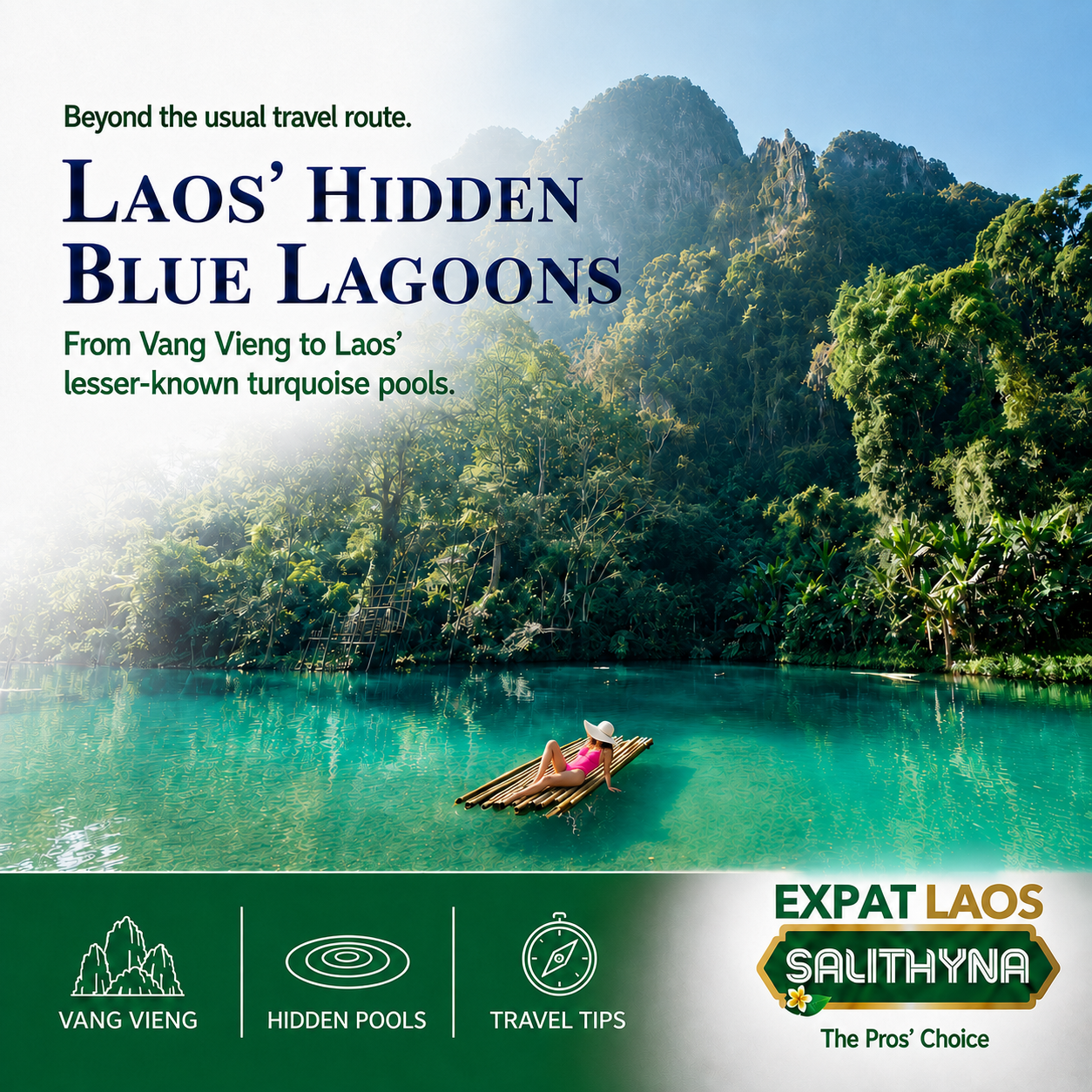
Few landscapes represent Laos as vividly as clear blue water beneath limestone cliffs and tropical forest. But “Blue Lagoon Laos” means several different things. Around Vang Vieng, travellers usually mean the numbered Blue Lagoons 1 to 6. Elsewhere, the same search leads to Kuang Si Falls near Luang Prabang, spring-fed pools in central Laos, or a remote crater lake near the Vietnamese border.
Laos has no single official registry of places called “Blue Lagoon”. This guide brings them together without pretending they are equivalent. Some are developed swimming attractions with changing rooms and food stalls. Others are seasonal waterfalls, protected lakes or remote natural sites where swimming may be restricted or unsafe. The right choice depends on your route, the season, and how much development you actually want.
⚡ QUICK ANSWER
For a first visit, Blue Lagoon 1 near Vang Vieng is the easiest and most famous choice, 7 km west of town and paired with Phu Kham Cave. Blue Lagoons 2 and 3 offer more space and activities; Blue Lagoons 4 and 5 are quieter and more local; Blue Lagoon 6 should be confirmed the same day before you travel. Outside Vang Vieng, Kuang Si Falls is the classic waterfall experience — open 08:00 to 17:30, 60,000 LAK for foreign visitors as of September 2026. Water colour, road access and swimming rules change with the weather, so verify locally on the day.
📋 8 Key Takeaways
- Six numbered Blue Lagoons are referenced around Vang Vieng; the first five are consistently reported as operating, the sixth is not.
- Blue Lagoon 1 sits about 7 km west of Vang Vieng, below Phu Kham Cave, and is the busiest from late morning onwards.
- Kuang Si Falls, 30 km from Luang Prabang, charges 60,000 LAK for foreign visitors and opens 08:00 to 17:30.
- Vang Vieng lagoon admission usually falls around 10,000 to 30,000 LAK, plus separate parking, bridge and activity charges, all in cash.
- The blue colour is a light effect, not a permanent property: heavy rain turns most of these pools brown, green or cloudy within hours.
- The dry season, roughly November to March or April, gives the clearest water and the easiest rural roads — Tad Sae is the exception and needs rainy-season flow.
- Khoun Kong Leng in Khammouane and Nong Fa in Attapeu are protected and culturally significant sites where swimming is not automatically permitted.
- Nong Fa is a crater lake at 1,154 metres, around 78 metres deep, 12 km from the Vietnamese border — an expedition, not a swimming stop.
🗺️ Blue lagoons and blue water in Laos, at a glance
| Place | Area | Best for | Important note |
|---|---|---|---|
| Blue Lagoon 1 | Vang Vieng | First visit, cave and easy access | Busy at peak hours |
| Blue Lagoon 2 | Vang Vieng | Families, space and activities | Longer ride west |
| Blue Lagoon 3 | Vang Vieng | Rope swing and adventurous feel | Loses sun in the afternoon |
| Blue Lagoon 4 | North of Vang Vieng | Quieter morning swim | Road and extra fees vary |
| Blue Lagoon 5 | Vang Vieng area | Remote, simple atmosphere | Water may look green or murky |
| Blue Lagoon 6 | Long Kuang area | Off-the-beaten-track option | Operating status inconsistent |
| Kuang Si Falls | Luang Prabang | Iconic multi-tier waterfall | Designated pools only |
| Tad Sae Falls | Luang Prabang | Rainy-season cascades | Can be nearly dry late in the dry season |
| Khoun Kong Leng | Khammouane | Dramatic limestone lake | Follow current village and site rules |
| Vang Nam Yen | Bolikhamxay | Cold spring on Route 8 | Local access conditions vary |
| Tha Falang | Khammouane | River swim near Thakhek | Best in calm dry-season water |
| Nong Fa Lake | Attapeu | Remote crater-lake expedition | Not a casual swimming stop |
1. Why is the water so blue?
The colour comes from a combination of clear water, pale limestone, dissolved minerals, sunlight and the surrounding forest. Fine suspended particles scatter light and make a pool look turquoise rather than transparent. The effect is optical and temporary: after heavy rain, runoff turns the same lagoon brown, green or cloudy, sometimes within a few hours.
This matters more than any place name. A vivid blue photograph taken in February tells you nothing about the same pool in August. Check recent local conditions, go early in the day when the light is low and the sediment has settled overnight, and never assume that blue-looking water is automatically clean, shallow or safe.
2. What are the six Blue Lagoons of Vang Vieng?
Vang Vieng is the centre of lagoon tourism in Laos, and the six numbered lagoons are spread through the karst countryside west and north of town. Distances below are approximate, mapping labels differ between apps, and rural road conditions change quickly after rain. Entrance and parking fees are paid in cash and can change without notice.
🔢 The six numbered lagoons compared
| Lagoon | Approximate distance | What you get | Watch out for |
|---|---|---|---|
| Blue Lagoon 1 | 7 km west | Jumping tree, Phu Kham Cave above, food stalls, facilities | Tour groups from late morning |
| Blue Lagoon 2 | about 13 km west | Two large pools, open resting areas, jumping points, short zipline | Confirm each activity is running before paying |
| Blue Lagoon 3 | about 16 km west | Rope swing, balance features, nearby cave, scenic ride | Direct sun disappears mid-afternoon |
| Blue Lagoon 4 | 30 to 40 minutes north | Clearer, quieter morning water; some reports of sauna facilities | Possible bridge or road charges on top of admission |
| Blue Lagoon 5 | 20 to 26 km out | Simple rural atmosphere, few facilities, low visitor numbers | Water often green rather than blue; check the road first |
| Blue Lagoon 6 | about 15 km, Long Kuang area | Listed with food and zipline in some directories | Recent guides describe it as closed or unreliable |
🔹 Blue Lagoon 1: the classic first stop
About 7 km west of central Vang Vieng, Blue Lagoon 1 is the best-known and easiest lagoon to fit into a short stay. Its pool sits below the entrance to Phu Kham Cave, so many visitors combine the swim with the cave climb, and a large tree provides the famous jumping platform. Food stalls, seating and basic facilities make it convenient. The trade-off is popularity: tour groups arrive from late morning in high season, so go near opening time for a calmer swim. Wear proper shoes for the cave — the limestone path is steep and slippery — and bring a headlamp.
🔹 Blue Lagoon 2: space for a relaxed day
Blue Lagoon 2 lies farther west, roughly 13 km from town depending on the route, with two large pools, open resting areas and a mix of activities that may include jumping points and a short zipline. The layout feels less compressed than Lagoon 1, which makes it a practical choice for families or groups staying several hours. It is a commercial attraction rather than a hidden secret, so expect changing facilities and local fees, and confirm that each activity is actually operating before paying for a package.
🔹 Blue Lagoon 3: activities in a rural setting
Blue Lagoon 3 sits around 16 km west of town, reached after a longer ride through rice fields and limestone scenery that is part of the appeal. Travellers come for the rope swing, zipline-style activities, balance features and a nearby cave. The pool loses direct sun later in the afternoon, so visit before mid-afternoon if vivid water colour and warmer swimming matter to you. Inspect the landing area before jumping, and do not copy risky behaviour you see other visitors attempting.
🔹 Blue Lagoon 4: the quieter alternative
Blue Lagoon 4 is generally reached north of Vang Vieng, with travel times around 30 to 40 minutes depending on the road and your starting point. It attracts visitors looking for clearer, quieter water in the morning, and recent travel reporting mentions sauna or steam-room facilities — though on-site services change. Some routes involve bridge or road charges on top of admission, so treat online prices as estimates, carry small kip notes and confirm the total before entering.
🔹 Blue Lagoon 5: remote and simple
Blue Lagoon 5 is one of the more distant numbered options, often described as 20 to 26 km from central Vang Vieng. Its attraction is a simple rural atmosphere rather than a list of facilities, and it can be genuinely peaceful when access is good and visitor numbers are low. Do not expect brilliant blue water every day: sediment, shade and rainfall regularly make it appear green or murky. Ask locally about the road before leaving, particularly in the wet season.
🔹 Blue Lagoon 6: verify before travelling
Blue Lagoon 6 is associated with the Long Kuang area, around 15 km from Vang Vieng in some listings. Current information is contradictory: official tourism directories have listed facilities such as food and zipline activities, while recent independent guides describe the site as temporarily closed, abandoned or unreliable.
⚠️ Do not build a day around Blue Lagoon 6
Confirm the site the same morning with your accommodation, a local driver or the village before setting out. If it is not operating, Blue Lagoon 4 or 5 gives you the same quiet rural experience with a far better chance of finding an open gate at the end of the road.
🔹 An unnumbered alternative: Tham Chang spring
Near Tham Chang Cave, a small natural spring pool offers a convenient swim close to town. It is not one of the numbered Blue Lagoons, but it works well for travellers who want a short outing without a long scooter or buggy ride. The water is typically cool, and the cave area adds cultural and historical interest. Vang Vieng’s newer attractions sit nearby too, including the glass bridge that has been reshaping tourism in the area.
3. Where is the blue water near Luang Prabang?
🔹 Kuang Si Falls: the iconic Laos experience
Kuang Si Falls, about 30 km from Luang Prabang, is the country’s best-known turquoise waterfall, descending through limestone terraces into a series of forest pools before the main cascade. Tourism Luang Prabang lists opening hours of 08:00 to 17:30 and an entrance fee of 60,000 kip for foreign visitors, with 20,000 kip for Lao citizens and free entry for children under 12. A Bear Rescue Centre operates inside the site at no extra charge.
The strongest blue tones appear in the drier months. During the wet season the falls become more powerful and the pools turn deep green rather than pale turquoise. Swimming is permitted only in designated areas, and the same official source asks visitors not to walk around shirtless or in bikini tops — modest swimwear is a matter of respect, not of rules alone.
🔹 Tad Sae Falls: beautiful but highly seasonal
Tad Sae lies southeast of Luang Prabang and is reached by road followed by a short boat crossing when the service is running. Its limestone terraces can be beautiful during and just after the rainy season. Late in the dry season, however, the falls may carry very little water. Choose Tad Sae only after checking current flow: it is not a reliable year-round substitute for Kuang Si, but in the right season it feels more intimate and more locally oriented.
4. What about turquoise pools in central Laos?
🔹 Khoun Kong Leng: a limestone lake with local rules
Khoun Kong Leng — also written Khun Kong Leng or Khoun Kong Lang — lies in Hinboun District, Khammouane Province, roughly 50 km north of Thakhek in the Phu Hin Boun foothills. An underground river feeds it through limestone, which gives the lake its bright emerald colour, and it reaches about 21 metres deep at the centre. Its name means “evening gong”, after a local tradition that the lake sounds a gong on full-moon nights.
Lao tourism promotion channels reported in March 2026 that a first phase of ecotourism facilities had opened at the site, but that development is not confirmed on the official Khammouane tourism portal, so treat it as unverified until you see it. What has not changed is the guidance that matters: older official advice asked visitors to consult the village before swimming and to use the stream near the bridge rather than the lake itself. Follow the current signs and staff instructions on the day, and never assume the main lake is open for swimming.
🔹 Vang Nam Yen, the Cool Pool: a Route 8 refresh
Vang Nam Yen is a cold, spring-fed turquoise pool in Khamkeut District, Bolikhamxay Province, roughly 35 km west of Lak Sao on Route 8. It is a useful stop for travellers driving the Thakhek Loop and far less internationally known than the Vang Vieng lagoons. The setting is local and the facilities are simple: ask before entering the water, keep noise low and take all rubbish away. English-language route guides often call it the Cool Pool.
🔹 Tha Falang: clear river water near Thakhek
Tha Falang, also written Tha Farang, is a river swimming and kayaking area around 16 km northeast of Thakhek. In favourable dry-season conditions the water looks emerald or turquoise, and it makes a pleasant half-day outing. Currents and clarity change after rain, so local judgement on the day matters far more than an old photograph.
🔹 The Kong Lor area and one marketing claim
Near Kong Lor, SpringRiver Resort organises guided swimming and kayaking trips on a clear river and promotes the experience as the “longest blue lagoon of Laos”. That phrase is an operator marketing claim, not a nationally certified record, and it should be read as such. The trip itself may still be an appealing guided option for travellers who want calm water and karst scenery without planning an independent route.
5. Which remote blue-water destinations exist in southern Laos?
🔹 Nong Fa Lake: a crater lake in Attapeu
Nong Fa — sometimes called Nongphatom or simply Blue Lake — is a remote crater lake in Sanxay District, Attapeu Province, inside the Dong Ampham National Biodiversity Conservation Area and about 12 km from the Vietnamese border. It sits at roughly 1,154 metres above sea level with a reported maximum depth of about 78 metres, though local residents dispute that figure. American pilots called it Dollar Lake during the Vietnam War, for its almost perfect circle.
This is an expedition, not a casual swimming stop. The lake carries real cultural significance — one local belief holds that a serpent in the water takes swimmers, while other communities say bathing brings eternal youth — road access can be difficult, and a knowledgeable local guide is strongly recommended. Visit in the dry season, respect local beliefs and do not enter the water unless current local rules clearly permit it.
🔹 Xe Bang Fai: a cave resurgence, not a lagoon
The Xe Bang Fai river cave in Khammouane is one of the great remote karst systems of Laos. A clear resurgence pool near Ban Nong Ping appears in some adventure itineraries, but the cave area requires serious logistics and experienced local guidance. Do not treat it as an ordinary roadside swimming attraction, and never assume that swimming is permitted or safe there.
6. Which blue lagoon should you choose?
🎯 Matching the site to your trip
| Your priority | Best match | Why |
|---|---|---|
| Only half a day in Vang Vieng | Blue Lagoon 1 | Easy to combine with Phu Kham Cave |
| Family or group day | Blue Lagoon 2 | More space and several pool areas |
| Activities and photographs | Blue Lagoon 3 | Rope swing and rural scenery on the way |
| A quieter Vang Vieng swim | Blue Lagoon 4 or 5 | Confirm road and water conditions first |
| Classic Luang Prabang day trip | Kuang Si Falls | Best-known waterfall, real infrastructure |
| Thakhek Loop stop | Vang Nam Yen | Cold spring directly beside Route 8 |
| Central Laos discovery | Khoun Kong Leng | Striking lake; check current swimming zones |
| Remote expedition | Nong Fa Lake | Guide, dry-season access and respect required |
7. When is the best time to visit blue lagoons in Laos?
For the clearest water and the easiest road access, the dry season from roughly November to March or April is the safest general choice. January and February usually combine low rainfall with pleasant temperatures, though popular sites are busier. The wet season, approximately May to October, creates lush scenery and stronger waterfalls, but also muddy roads, reduced visibility, stronger currents and rapid water-level changes.
📅 What each period actually gives you
| Period | Water and access | Best strategy |
|---|---|---|
| November to February | Clearest blue water, dry rural roads, cooler air | Go early; expect company at Blue Lagoon 1 and Kuang Si |
| March to April | Easy access, but smaller cascades and seasonal haze | Good for Vang Vieng lagoons, poor for Tad Sae |
| May to October | Powerful waterfalls, green or brown pools, muddy tracks | Best season for Tad Sae; check roads before every trip |
| After heavy rain, any month | Cloudy water, stronger flow, difficult rural roads | Postpone a day, or choose a developed site with real access |
Timing within the day matters as much as the month. Early morning brings fewer visitors, cooler air and calmer photography conditions, while public holidays and weekends fill the popular lagoons with local and international visitors alike. The dry-season window also overlaps with the festival calendar, covered in our 2026–2027 cultural calendar.
8. How do you swim safely and respectfully?
Natural pools are not controlled swimming pools. Depth, underwater obstacles, current and water quality change from one visit to the next, and a site that looked safe online may be different after a storm.
- Check depth before jumping, and never dive into water you have not inspected yourself.
- Obey closure signs and designated swimming zones, especially at Kuang Si and Khoun Kong Leng.
- Use secure footwear for cave paths, wet limestone and muddy rural tracks.
- Keep children within arm’s reach; life jackets are sensible wherever current or depth is uncertain.
- Avoid alcohol before swimming, climbing, rope swings or scooter travel.
- Dress respectfully — many of these sites are used by Lao families and several carry spiritual importance.
- Carry cash, water, sun protection and offline directions; phone coverage is weak in most of these valleys.
- Leave no rubbish, and avoid soaps, shampoos or chemical sunscreens directly before entering sensitive pools.
9. What do good blue-lagoon itineraries look like?
🔹 One day in Vang Vieng
Start early at Blue Lagoon 1 and climb to Phu Kham Cave if conditions are dry. Continue to Blue Lagoon 2 or 3 for lunch, swimming and a longer rest. Return before dark: rural roads are much harder to read after sunset, and this is when most scooter accidents happen.
🔹 Two days in Vang Vieng
On the first day, pair Blue Lagoon 1 with a cave or viewpoint close to town. On the second, choose Blue Lagoon 3 for activities, or Blue Lagoon 4 or 5 for a quieter experience. Anyone considering more than a holiday in the area will find the practical detail in our guide to moving to Pakse or Vang Vieng.
🔹 A central Laos road trip
Use Thakhek as a base and include Tha Falang if the river is calm. Stop at Vang Nam Yen while crossing Route 8 toward Lak Sao and Kong Lor. Add Khoun Kong Leng only with enough time to confirm access and current site rules on arrival rather than in advance.
🌿 When a short trip becomes a plan to stay
Expat Laos SALITHYNA helps travellers who fall for Laos understand the country properly, find a suitable home with LAO Villa SALITHYNA and organise a smoother arrival with practical local support. Discover our services and local expertise. expatlaos-salithyna.com
WhatsApp: +856 20 57 935 574 — Email: contact@salithynagroup.com
❓ Frequently asked questions
How many Blue Lagoons are there in Vang Vieng?
Six numbered lagoon sites are commonly referenced around Vang Vieng: Blue Lagoons 1 to 6. The first five are consistently reported as operating, while information about Blue Lagoon 6 is contradictory between official directories and recent independent guides. Verify Blue Lagoon 6 locally on the day before travelling there.
Which Blue Lagoon in Vang Vieng is best?
Blue Lagoon 1 is best for a first-time visitor who wants easy access and Phu Kham Cave, 7 km west of town. Blue Lagoon 2 suits families and groups with its two large pools, Blue Lagoon 3 suits activities and a rope swing, and Blue Lagoons 4 or 5 are better bets for a quiet rural atmosphere.
Is Kuang Si Falls a Blue Lagoon?
No. Kuang Si is a multi-tier waterfall with naturally turquoise limestone pools near Luang Prabang, not one of Vang Vieng’s numbered lagoons. It is nevertheless the most famous blue-water destination in Laos, and for many travellers the single best day trip in the country.
How much does Kuang Si Falls cost?
Entry is 60,000 kip for foreign visitors and 20,000 kip for Lao citizens, with children under 12 free, according to Tourism Luang Prabang at the time of writing. The site opens daily from 08:00 to 17:30. The Bear Rescue Centre inside the grounds is included at no extra charge.
How much do the Vang Vieng Blue Lagoons cost?
Admission commonly falls in a modest local range, often around 10,000 to 30,000 LAK, but parking, bridge charges and individual activity fees are usually separate. Carry small kip notes and confirm the total on arrival rather than relying on an online price from last season.
Can you swim in every blue lake or lagoon in Laos?
No. Swimming is allowed only where current local rules permit it. Some lakes are protected, culturally significant, very deep or simply unsafe — Khoun Kong Leng and Nong Fa are both in that category. Follow signs and ask local staff or village authorities before entering the water.
When is the water bluest in Laos?
Clearer blue water appears during the dry season, especially after several rain-free days, with January and February the most reliable months. Heavy rain makes pools cloudy or green within hours. Seasonal waterfalls such as Tad Sae are the exception and need rainy-season flow to be worth the trip.
Is Vang Vieng safe for swimming?
The developed lagoons are reasonable when you take normal precautions: check depth before jumping, avoid alcohol before swimming or riding, wear proper footwear on limestone, and keep children within reach. Most serious incidents around Vang Vieng involve alcohol, unchecked jumps or scooter journeys after dark rather than the water itself.
📚 Sources and fact-check references
- Tourism Luang Prabang — Kuang Si Waterfall, opening hours, fees and visitor conduct
- Khammouane Tourism — official provincial portal, Khoun Kong Leng listing
- Khoun Kong Leng Lake — location, depth, underground river and the evening-gong tradition
- Nong Fa Lake — altitude, reported depth, Dong Ampham conservation area and local beliefs
- Discover Laos Today — destination directory used for cross-checking site listings
Last updated September 2026. Entrance fees, opening hours, road conditions and swimming rules at these sites change frequently and are often set locally. Prices quoted here were verified in September 2026 and should be treated as indications. Reports of new facilities at Khoun Kong Leng could not be confirmed on an official provincial source and are presented as unverified.
🔗 Continue exploring life and travel in Laos
- Why Everyone Is Talking About Laos in 2026 — why these valleys are busier than they were, and how the railway changed who reaches them.
- Glass Bridge Near Vang Vieng: The New Attraction Reshaping Tourism in Laos — the other reason travellers now stay in Vang Vieng for more than one night.
- 10 Things to Do in Laos: Explore the Land of a Million Elephants — how a lagoon day fits into a wider route through the country.
- Lao Coffee Guide 2026: Bolaven Plateau, Specialty Beans and the Best Coffee Experiences — the southern plateau, its waterfalls and the coffee that grows between them.
- Laos Airports: The Complete 2026 Guide for Expats — reaching Luang Prabang, Thakhek and the south without wasting days in transit.
By Clem-Titsada, co-founder of Salithyna Group. Franco-Lao and based in Vientiane, she has been developing professional services adapted to international standards and to the realities of Laos since 2022.



Join The Discussion