 by
by 
- A new tourist glass bridge is now open near Vang Vieng, spanning a spectacular gorge.
- This attraction is part of the Laos Tourism Development Plan 2026–2030, focused on sustainability and connectivity.
- The Laos-China Railway makes Vang Vieng an easy stop between Vientiane and Luang Prabang, multiplying short-stay visitors.
- The town has completed its transformation: from party capital to an adventure and eco-tourism destination.
- For expats, this momentum creates real opportunities in real estate, services, and visitor hosting.
Vang Vieng now has a new thrill-seeking attraction: a glass bridge that overlooks a spectacular gorge, presented as one of the flagship experiences for adrenaline lovers, alongside the hot-air balloon flights already well established in the region.
The concept is simple and remarkably effective: walking on a transparent walkway, suspended over the void, with Vang Vieng’s famous karst peaks as a backdrop. This is exactly the kind of experience that generates viral content on social media and attracts a new generation of travelers.
This concept has already proven itself across Asia. Neighboring countries have multiplied these structures with considerable success. Vietnam, for example, has several glass bridges that have become tourist magnets, one of which even holds a world record for length. Laos is now following this regional trend.
This bridge is not an isolated project. It is part of a broader vision: the Laos Tourism Development Plan 2026–2030.
This ambitious plan aims for a balance between economic growth, environmental protection, and cultural preservation. The Lao government seeks to position the country as a global destination for cultural and eco-tourism, following the success of the “Visit Laos Year 2024” campaign.
| Indicator | Data |
|---|---|
| Visitors in 2025 | + 4.5 million arrivals |
| Tourism plan horizon | 2026–2030 |
| Priority markets | Thailand, China, Vietnam, Korea |
| Strategic focus | Regional connectivity + sustainability |
This strategy rests on three pillars: infrastructure improvement, cultural heritage enhancement, and strengthened regional and international accessibility.
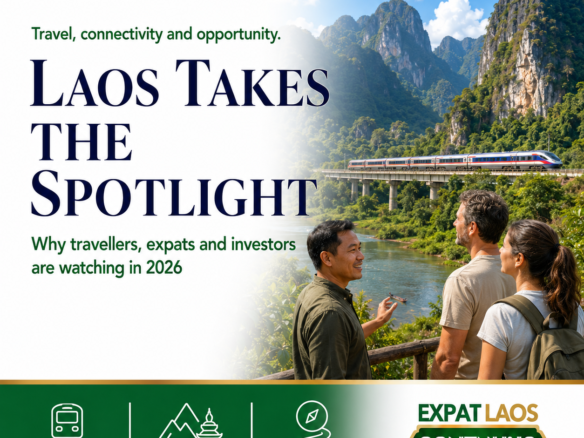
You can’t talk about Vang Vieng’s tourism boom without mentioning the Laos-China high-speed railway.
With this line in service, Vang Vieng has become an easy stop between Vientiane and Luang Prabang. The result: far more short-stay travelers, and far fewer backpackers “stuck” on site for weeks.
The visitor profile has evolved. We now see tourists arriving to spend one or two nights, looking for well-organized and photogenic activities — exactly the niche a glass bridge fills. This clientele spends differently: it favors comfort, turnkey experiences, and quality accommodation.
For those tracking the real estate and services market in Laos on expatlaos-salithyna.com, this shift in the tourist profile is a strong signal. Demand is moving toward the upper end and toward packaged services.
Vang Vieng long carried a controversial reputation. In the 2000s, the town was one of the most famous — and controversial — stops on the Southeast Asian backpacker trail, centered on tubing and river bars.
The government called time on the party. The riverside bars were demolished, tubing rules tightened, and the town pushed firmly toward a future focused on eco-tourism.
The result is a transformed town. The karst landscapes have finally become the main attraction again. Alongside the new glass bridge, visitors enjoy a whole range of activities:
| Activity | Type of experience |
|---|---|
| Glass bridge | Thrills, panorama |
| Hot-air balloon | Aerial view, around USD 80–100 |
| Kayaking on the Nam Song | Nature, sporty |
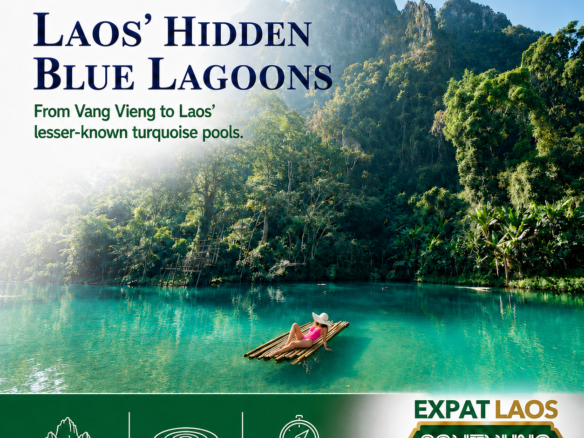
| Blue Lagoons | Swimming, relaxation |
| Karst caves | Caving, adventure |
| Viewpoints (Nam Xay) | Hiking, photography |