
 by
by 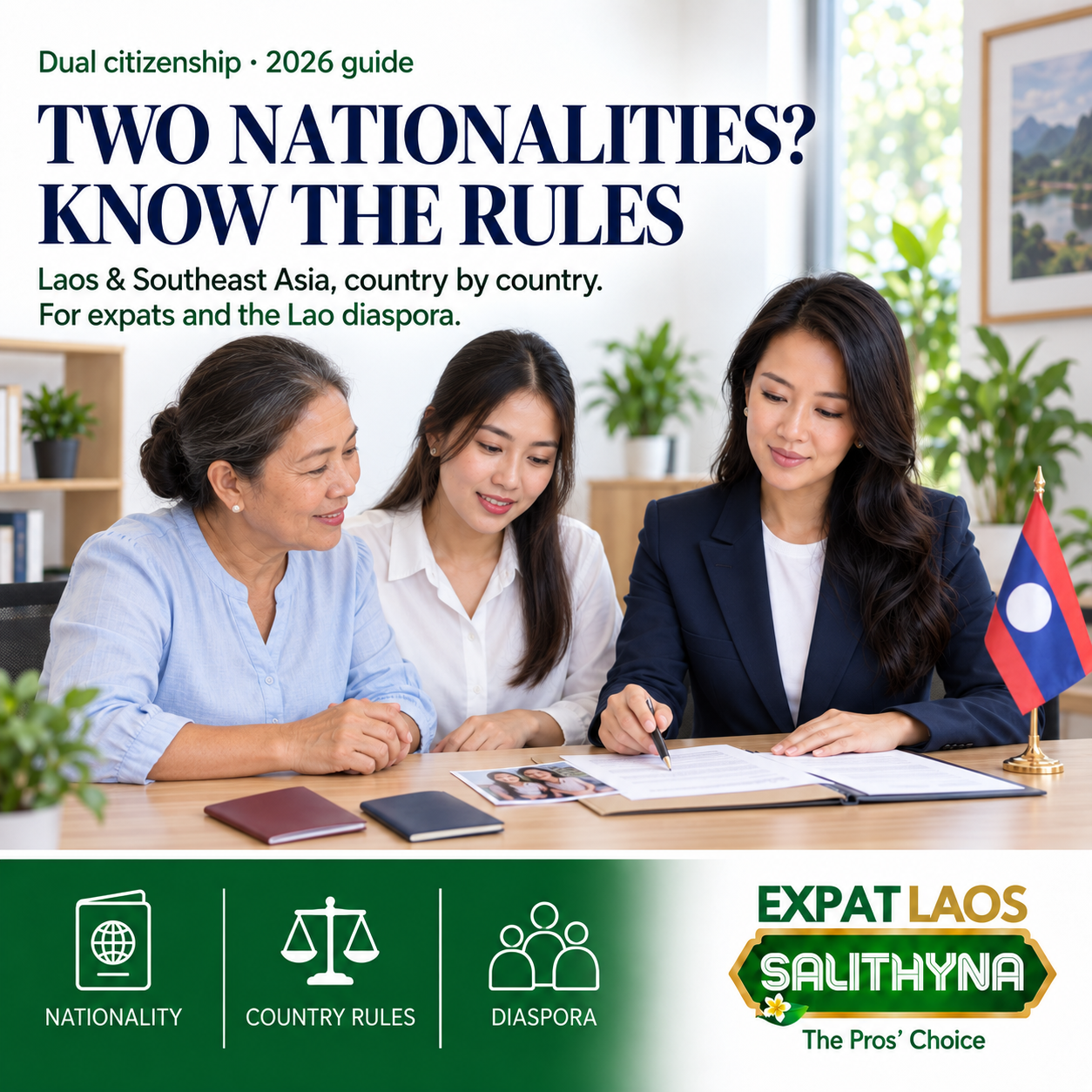
Dual citizenship in Laos is not available as a general right in 2026. The amended Law on Lao Nationality of 2017 keeps a single-nationality principle, and an ordinary foreign applicant must renounce a previous nationality to become Lao. Elsewhere in Southeast Asia, Cambodia and Timor-Leste accept dual citizenship broadly, Vietnam and the Philippines accept it for specific groups, and Thailand tolerates it with caveats.
This guide is written for two readers: the long-term expatriate who wonders whether naturalisation would cost them their passport, and the member of the Lao diaspora who wants a Lao passport alongside the one they already hold.
⚡ QUICK ANSWER
As of 18 September 2026, Laos does not grant a general right to dual citizenship. The 2017 Law on Lao Nationality applies a single-nationality rule and normally requires naturalisation applicants to renounce their previous nationality. People with a Lao parent have a separate application route, and published translations disagree on whether they must also renounce. Honorary citizenship remains an individual exception. Article 47 of the 2025 Constitution recognises Lao people abroad as part of the national community, but no dual-citizenship bill has been announced.
📋 5 Key Takeaways
- France and the United States both allow their citizens to hold another nationality. The deciding law is the law of the host country.
- Cambodia and Timor-Leste accept dual citizenship most broadly; Vietnam has allowed it selectively since 1 July 2025.
- Laos applies a single-nationality principle under the 2017 Law on Lao Nationality; ordinary naturalisation takes ten years of residence and renunciation.
- People with a Lao parent can apply after five years of residence, but whether they must renounce is not settled by the published English translations.
- Honorary Lao citizenship remains an individual exception, including for investors under Decree No. 14 of 2022.
1. Do French or American citizens lose their nationality when they naturalise in Southeast Asia?
No. The French Ministry for Europe and Foreign Affairs confirms, in a page updated on 29 May 2026, that a French citizen who acquires another nationality keeps French nationality unless they deliberately renounce it. The US Department of State states that US law does not require a citizen to choose between US citizenship and another nationality.
The deciding rule is therefore the host country’s law.
2. Which Southeast Asian countries allow dual citizenship in 2026?
According to the Statelessness Encyclopedia Asia Pacific, Cambodia and Timor-Leste are the only two states in the region that allow dual citizenship broadly; Laos, the Philippines, Thailand and Vietnam allow it for certain groups only.
📊 Dual citizenship for a foreign national who naturalises: 11-country comparison (September 2026)
| Country | Can you keep your original nationality? | Legal basis and main condition |
|---|---|---|
| Cambodia | Yes | Law on Nationality 1996; royal decree |
| Timor-Leste | Yes | Law No. 9/2002; 10 years’ residence |
| Thailand | Often, with caveats | Nationality Act; 5 years’ domicile, Thai language |
| Vietnam | Yes, for eligible groups | Law No. 79/2025/QH15; family ties or merit, presidential approval |
| Philippines | Mainly for Filipinos by birth | Republic Act No. 9225 (2003) |
| Laos | No, except individual cases | Law on Lao Nationality 2017; honorary citizenship as exception |
| Brunei | No | Restrictive nationality law |
| Indonesia | No, for adults | Law No. 12/2006; opening proposed 14 August 2026 |
| Malaysia | No | Not recognised |
| Myanmar | No | Citizenship Law 1982 |
| Singapore | No, for adults | Not recognised for adults |
3. Which countries are the most open: Cambodia, Timor-Leste and Thailand?
🇰🇭 Cambodia: dual nationality permitted, naturalisation discretionary
Cambodia’s Law on Nationality of 9 October 1996 does not require a naturalised citizen to give up a previous nationality. The text published on Refworld states that naturalisation is a favour of the Kingdom, not a right, and that each grant is decided by royal decree.
🇹🇱 Timor-Leste: explicit recognition, strict residence test
Timor-Leste’s Law No. 9/2002 on Citizenship states that granting Timorese citizenship does not affect legal relationships already established on the basis of another citizenship. The text published by the Timor-Leste Immigration Service requires at least ten years of usual and regular residence after 20 May 2002 and the ability to speak Tetum or Portuguese.
🇹🇭 Thailand: tolerated in practice, less clear for naturalised citizens
Thailand’s Nationality Act contains no general ban on dual nationality. Naturalisation normally requires five years of domicile, Thai language ability and a steady occupation, and sources disagree on whether a declaration of intent to renounce is still requested, as the GLOBALCIT report on Thai citizenship law (2023) explains.
⚠️ Accepted is not the same as accessible
A country that accepts dual citizenship can still run a long and discretionary naturalisation process. Marriage, permanent residence or a property purchase creates no automatic right to citizenship anywhere in the region.
4. Where is dual citizenship allowed only for specific groups: Vietnam and the Philippines?
🇻🇳 Vietnam: a selective opening since 1 July 2025
Vietnam’s National Assembly adopted Law No. 79/2025/QH15 on 24 June 2025, and it entered into force on 1 July 2025. According to Vietnam Law Magazine’s analysis of the 2025 reform, Article 1.6 of the law allows applicants to retain a foreign nationality when they naturalise if they have a Vietnamese spouse or biological child, a Vietnamese parent or grandparent, recognised merit, or a naturalisation deemed beneficial to Vietnam. Each case still requires the approval of the President of Vietnam.
🇵🇭 Philippines: dual citizenship for Filipinos by birth
Republic Act No. 9225, in force since 17 September 2003, allows natural-born Filipinos who naturalised abroad to retain or reacquire Philippine citizenship by taking an oath of allegiance, as explained by the Philippine Embassy in Hanoi. A foreigner with no Filipino parentage follows the ordinary naturalisation route instead.
5. What does Lao law actually say about dual citizenship in 2026?
The governing text is the Law on Lao Nationality No. 29/NA of 1 November 2017, whose Article 6 forbids Lao citizens from holding several nationalities. The Lao-language version prevails; the English version circulated on the Lao Services Portal of the Ministry of Industry and Commerce is a working translation.
🔸 Ordinary naturalisation: ten years and renunciation
A foreign applicant must, among other conditions, speak Lao, be integrated, have stable means and have lived continuously in Laos for ten years, and must renounce any previous nationality. When the National Assembly passed the amendment, the Vientiane Times report republished by JC Lao stated that highly qualified experts and major contributors could apply after five consecutive years instead of ten.
🔸 Honorary citizenship: the exception for exceptional contributors
The 2017 law lets the government grant honorary citizenship to an outstanding contributor who cannot renounce an original nationality. Article 51 of the 2025 Constitution confirms this exception.
📊 The four routes to Lao nationality and the renunciation question
| Route | Who it covers | Residence required | Renunciation of other nationality |
|---|---|---|---|
| Citizenship at birth | Child of two Lao citizens, wherever born; some children of one Lao parent | None | Not an application; single-nationality principle still applies |
| Ordinary naturalisation | Foreign nationals and stateless persons | 10 years; reduced for experts and major contributors | Required, except for stateless persons |
| Application by a person of Lao race | Person with at least one Lao-citizen parent | 5 years with another nationality; 3 years without | Unclear: translations disagree (see below) |
| Honorary citizenship | Exceptional contributors who cannot renounce | Decided case by case | Not required |
The figures to remember: ten years of residence for ordinary naturalisation, five years for a person of Lao race who already holds another nationality.
⚠️ Two readings of the same rule are circulating
The 2004 law exempted people of Lao race from renunciation (“except for paragraph 9”). The English translation of the 2017 law still contains those words, but refers to an article number carried over from 2004. Some analyses conclude the exception survived, others that renunciation now applies to everyone. Until the Lao Ministry of Justice confirms in writing, do not renounce on the strength of either reading.
🔸 Who counts as a “person of Lao race”?
The 2017 law defines a person of Lao race as someone with at least one Lao-national parent. A Lao grandparent alone is not enough under the current wording.
🔸 Restoration and loss of Lao nationality
The 2017 law allows restoration of Lao nationality, subject to government approval. It also lists grounds for losing it, including more than seven years abroad without authorisation, so many overseas Lao should first check whether their nationality still exists.
6. Can investment or buying property lead to Lao citizenship?
Buying property in Laos creates no right to Lao citizenship. Our guide to real estate in Laos for foreign investors explains what foreigners can and cannot hold.
A separate investor route exists through honorary citizenship. Decree No. 14 of 2022 sets criteria for honorary Lao citizenship, including, for business applicants, a donation of at least usd 500,000 to socio-economic development and at least usd 1 million of investment in Laos before applying, as reported by Radio Free Asia in October 2022. Honorary status allows permanent residence but is not the same as full citizenship.
7. What does the Billy Ketkeophomphone case really prove?
Billy Ketkeophomphone is a footballer born in France in 1990 to Lao refugee parents. According to the Laotian Times, he received honorary Lao citizenship and a Lao passport at the Lao Embassy in Paris on 25 November 2021, before joining the national team.
The case proves that Laos can make an individual exception for a person of Lao descent. It does not create a right for the wider diaspora, and the underlying decision has not been published.
8. Could Laos open dual citizenship to its diaspora?
The strongest signal is Article 47 of the Constitution amended on 20 March 2025. In the English translation circulated by BritCham Laos, it declares that Lao people living abroad are an inseparable part of the national community.
Article 47 grants no passport by itself, but it recognises Lao people abroad who now hold only a foreign nationality. Future legislation can build on that.
Laos has also started building a diaspora policy. On 12 November 2024, the Lao News Agency (KPL) reported that about 981,900 Lao nationals live in 18 countries and that Decree No. 475 simplifies visa and residence procedures for them.
The regional context points the same way. On 14 August 2026, Indonesian President Prabowo Subianto told parliament that his government would propose limited dual citizenship for selected talent needed by the nation, according to Antara News Agency. It is a proposal, not a law, but it confirms a regional trend towards controlled openings.
In our assessment at Expat Laos SALITHYNA, the most plausible path is gradual: easier visas and restoration procedures first, then selective dual citizenship for direct descendants and selected talent, as in Vietnam. As of 18 September 2026, no bill or timetable has been announced.
9. Which countries refuse dual citizenship for adults?
Brunei, Indonesia, Malaysia, Myanmar and Singapore do not recognise dual citizenship for adults. Indonesia’s Law No. 12 of 2006 only lets children of mixed marriages hold two nationalities temporarily. In these five countries, naturalisation means giving up the original passport, and a long-term residence permit is usually the better tool.
10. What should you check before applying for a second nationality?
- Identify your route: descent, restoration, marriage, naturalisation or special contribution.
- Check whether the current text lets you keep your other nationality, in the language that prevails.
- For Laos, gather birth certificates, family books, former passports and refugee documents.
- Get a written answer from the Lao Ministry of Justice or a Lao embassy on renunciation.
- Never renounce a nationality or invest heavily on the strength of an informal promise.
Securing residence and housing comes first; start with our step-by-step guide to obtaining a Lao visa.
11. So, can you keep both passports in Southeast Asia?
Yes in Cambodia and Timor-Leste, often in Thailand, and in Vietnam if you have Vietnamese family ties or recognised merit. In Laos, not as a general right: ordinary naturalisation requires renunciation, the diaspora route is legally ambiguous, and honorary citizenship remains an individual decision.
Laos has nevertheless moved, through diaspora visas and Article 47 of its Constitution. The most realistic next step is a selective opening on the Vietnamese model.
🌿 Planning a long-term life in Laos?
Expat Laos SALITHYNA helps individuals, families and companies settle in Laos: housing search, relocation, visa assistance and administrative formalities. If you have Lao parents or former Lao documents, we can help you prepare a first documentary checklist. Discover our services and local expertise. expatlaos-salithyna.com
WhatsApp: +856 20 57 935 574 — Email: contact@salithynagroup.com
❓ Frequently asked questions
Does Laos allow dual citizenship in 2026?
Laos does not allow dual citizenship as a general right in 2026. The 2017 Law on Lao Nationality applies a single-nationality principle and requires ordinary applicants to renounce their previous nationality. Honorary citizenship and the route for people with a Lao parent are handled case by case.
Can a French citizen of Lao origin hold both passports?
France allows it, so the obstacle lies in Lao law. A French citizen with a Lao parent can apply after five years of residence in Laos, but translations disagree on whether renunciation is required. Get written confirmation from the Lao Ministry of Justice first.
Does marrying a Lao citizen give Lao nationality?
Marriage to a Lao citizen does not automatically confer Lao nationality. The foreign spouse keeps their own nationality and must meet the naturalisation conditions of the 2017 law, including renunciation, to become Lao.
Can buying property in Laos lead to citizenship?
An ordinary property purchase in Laos never leads to citizenship. The only investment-linked route is honorary citizenship under Decree No. 14 of 2022, which for business applicants requires a donation of at least usd 500,000 and at least usd 1 million of investment, and which remains a discretionary government decision.
📚 Sources and fact-check references
- Lao PDR — Law on Lao Nationality No. 29/NA (2017) and No. 05/NA (2004)
- Lao PDR — Constitution No. 77/NA, 20 March 2025, Articles 47 and 51
- KPL — Annual Gathering for Overseas Nationals, 12 November 2024
- Radio Free Asia — Decree No. 14 on honorary citizenship, October 2022
- Vietnam Law Magazine — Law No. 79/2025/QH15
- Antara — Indonesia’s dual citizenship proposal, 14 August 2026
- Laws of Cambodia (1996), Timor-Leste (2002) and the Philippines (RA 9225)
- GLOBALCIT (EUI) and Nationality For All — regional reports
- French Ministry for Europe and Foreign Affairs; US Department of State
Last updated 18 September 2026. This article provides general information and is not legal advice. Nationality decisions are individual and discretionary, and the official Lao-language text published in the Official Gazette prevails over any translation. Obtain written confirmation from the competent authorities and, where necessary, independent legal advice.
🔗 Continue exploring life and business in Laos
- Laos Visa 2025–2026: Complete Guide to the Short-Stay Tourist Visa — entry rules before any long-term plan.
- Retiring in Laos: The Complete Guide for Expat Seniors — settling for good without changing nationality.
- Where to Live in Vientiane in 2026? Best Neighborhoods for Expats — the first thing to secure when you move.
- Cost of Living in Laos: A Guide for Expats — budgeting the years of residence any route requires.
- Doing Business in Laos in 2026: Costs, Salaries, Company Setup — for diaspora entrepreneurs and investors.
By Clem-Titsada, co-founder of Salithyna Group. Franco-Lao and based in Vientiane, she has been developing professional services adapted to international standards and to the realities of Laos since 2022.
Join The Discussion